Asscher Cut vs. Radiant Cut: Which Diamond Is Better for You?
Quick Answer: Asscher cut vs radiant cut: the biggest difference is how they reflect light. Asscher diamonds produce broad, mirror-like flashes through their step-cut facets, creating the distinctive hall of mirrors effect. Radiant diamonds feature brilliant-style faceting for livelier sparkle. Choose Asscher for vintage Art Deco elegance or radiant for bold brilliance and a more contemporary look.
At first glance, these two diamond shapes can look surprisingly similar. Both feature geometric outlines and clipped corners. But watch them move under the same light, and the difference becomes clear. An Asscher draws your eye into its layered reflections, while a radiant catches the light with quick, lively flashes.
So, which diamond cut is right for your engagement ring? Let's compare their sparkle, size, clarity, and settings to help you decide.
Asscher Cut vs. Radiant Cut: Key Differences in Shape and Sparkle
Developed by Joseph Asscher in 1902 and popularized during the Art Deco period, Asscher cut diamonds are known for their square shape, cropped corners, high crown, and broad step-cut facets.
These open facets create the hall of mirrors effect, producing deep, elegant reflections rather than the rapid glitter associated with a round brilliant cut. The result is a distinctive geometric appearance with plenty of vintage charm.
A radiant cut diamond offers something different. Introduced in 1977, the radiant cut combines the angular outline of an emerald cut with the sparkle of a modified brilliant cut.
Available in square or rectangular shapes, radiant diamonds produce more frequent flashes of light. Some display a fine, shimmering pattern known as crushed ice, while others have larger, more defined reflections.
Here are the key differences:
|
Feature |
Asscher Cut |
Radiant Cut |
|
Shape |
Square with cropped corners |
Square or rectangular with clipped corners |
|
Faceting |
Broad step-cut facets |
Modified brilliant facets |
|
Sparkle |
Deep, mirror-like flashes |
Lively, brilliant sparkle |
|
Appearance |
Geometric and refined |
Bold and eye-catching |
|
Style |
Vintage, Art Deco |
Modern and versatile |
|
Clarity Visibility |
Inclusions may be easier to notice |
Faceting can help disguise some inclusions |
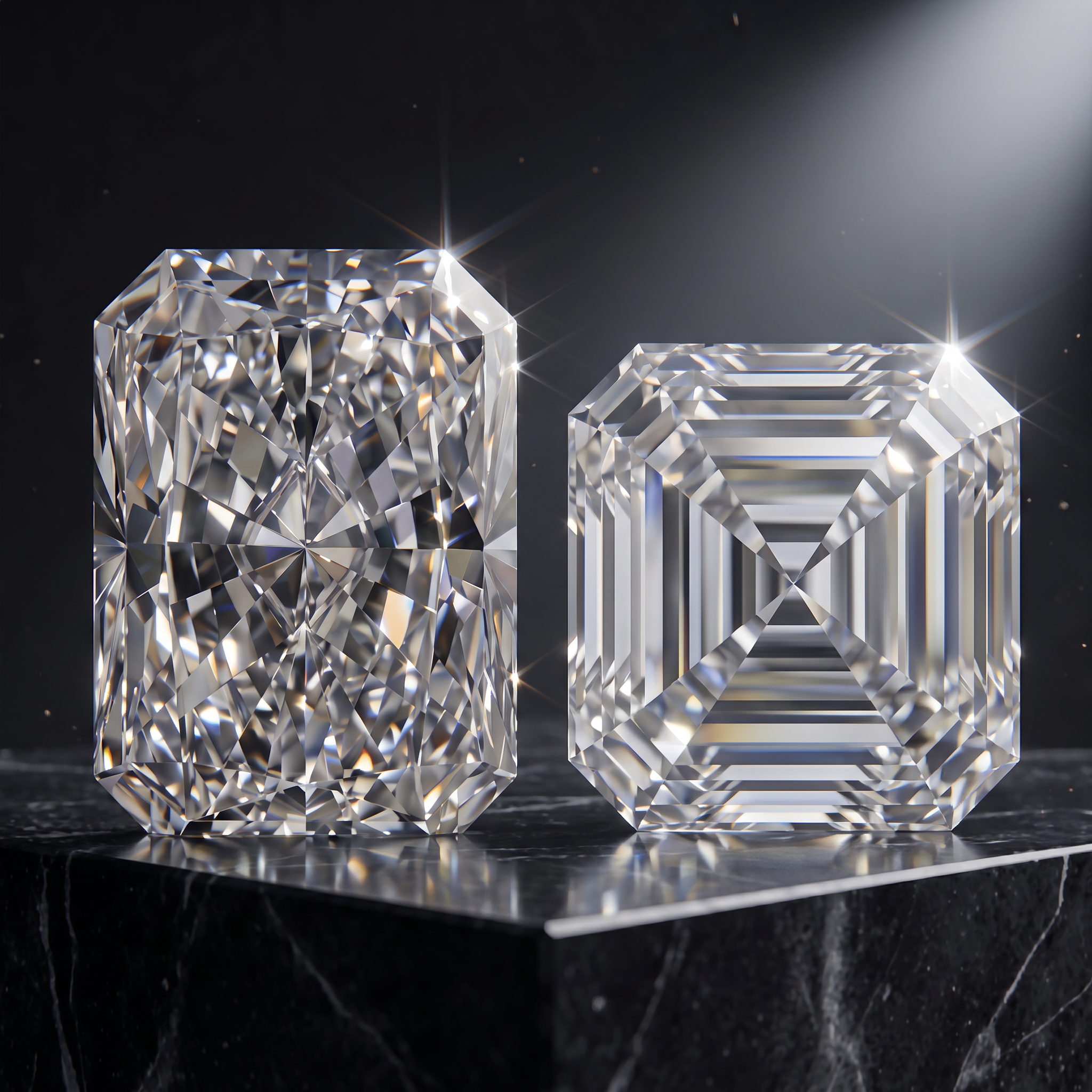
Neither diamond shape is inherently more beautiful. Asscher offers clean lines and understated elegance, while radiant delivers energetic sparkle with a modern twist.
Compare Leonids' Asscher Cut Engagement Rings and Radiant Cut Engagement Rings to see how these differences translate into real ring designs.
Asscher vs. Radiant Cut: Size, Clarity & Everyday Wear
Which looks bigger at the same carat weight?
Carat weight measures how much a diamond weighs, not how large it appears on your finger.
Asscher cut diamonds often have a deep pavilion, meaning some of their weight sits below the visible surface. Radiant diamonds, especially those with an elongated shape, can create a longer, slimmer appearance.
Consider two 2 carat lab grown diamonds from Leonids:
|
Leonids Ring |
Center Stone |
Measurements |
|
2 CT |
6.9 × 6.9 mm |
|
|
2 CT |
8.5 × 6.0 mm |
Prefer a longer, slimmer silhouette? Serene's radiant shape may suit you. Like a balanced square with more width across the finger? Thea's Asscher cut is worth a closer look.
Does clarity matter more for Asscher cut diamonds?
Asscher's large, open facets can make inclusions and subtle color differences easier to notice. Radiant's more intricate reflections may disguise some of these details, although every diamond should be evaluated individually.
Leonids lists D/E color and VS clarity for both designs. Before ordering, compare the available product images and center-stone specifications, and review the IGI certification policy. Leonids provides sample grading reports before purchase, while the final report details for your diamond are provided after your order ships.
What about everyday wear?
Both cuts feature trimmed corners, but the chosen setting matters just as much as the diamond shape.
Thea's hidden halo and pavé band add delicate sparkle around its Asscher center, while Serene's round side diamonds give its elongated radiant a more detailed silhouette.
For everyday comfort, compare the prong setting, ring height, and side profile, especially if you plan to pair your engagement ring with a wedding band.
Before buying online, also check the ring size, metal options, estimated production time, and applicable resizing and return policies.
Asscher Cut vs. Radiant Cut: Which Should You Choose?
Choose an Asscher Cut If You Love Vintage Elegance
If you're drawn to Art Deco architecture, geometric symmetry, and understated luxury, an Asscher cut diamond may feel like the perfect fit.
Its hall of mirrors effect gives the center stone depth and character without overwhelming the design. Vintage-inspired settings, hidden halos, and pavé details can introduce extra brilliance while preserving the Asscher's distinctive appearance.
Leonids' Thea combines a square Asscher diamond with a hidden halo, cathedral profile, and pavé band. For a softer contrast to the geometric center stone, its twisted-band designs offer another option.
Choose a Radiant Cut If You Prefer Bold Sparkle
If you love the lively sparkle of round diamonds but prefer an elongated or square shape, a radiant diamond is worth considering.
Its modified brilliant faceting creates energetic reflections, while side stones and three-stone designs can make the overall ring more striking.
Leonids' Serene pairs an elongated radiant center with round diamond accents, offering a more detailed look without losing the clean geometry of the center stone.
Both styles are available with lab grown diamonds, which have essentially the same physical, chemical, and optical properties as mined diamonds.
Ultimately, choosing between Asscher and radiant comes down to the reflections you love, the proportions that suit your hand, and the setting you'll enjoy wearing every day.
Explore Leonids' Asscher and Radiant collections to find a ring that brings those details together.
Share