

IN THIS GUIDE:
- What Is an IGI Lab-Grown Diamond Report?
- What’s Inside an IGI Report?
- What You Really Need to Check
- Why IGI Over GIA for Lab-Grown Diamonds?
- Verify an IGI Report Online
- Loose Diamond Reports and Finished Jewelry Reports
- Single Diamond Weight and Total Carat Weight
- Reports Included With a Leonids Order
What Is an IGI Lab-Grown Diamond Report?
Think of it as your diamond’s passport.
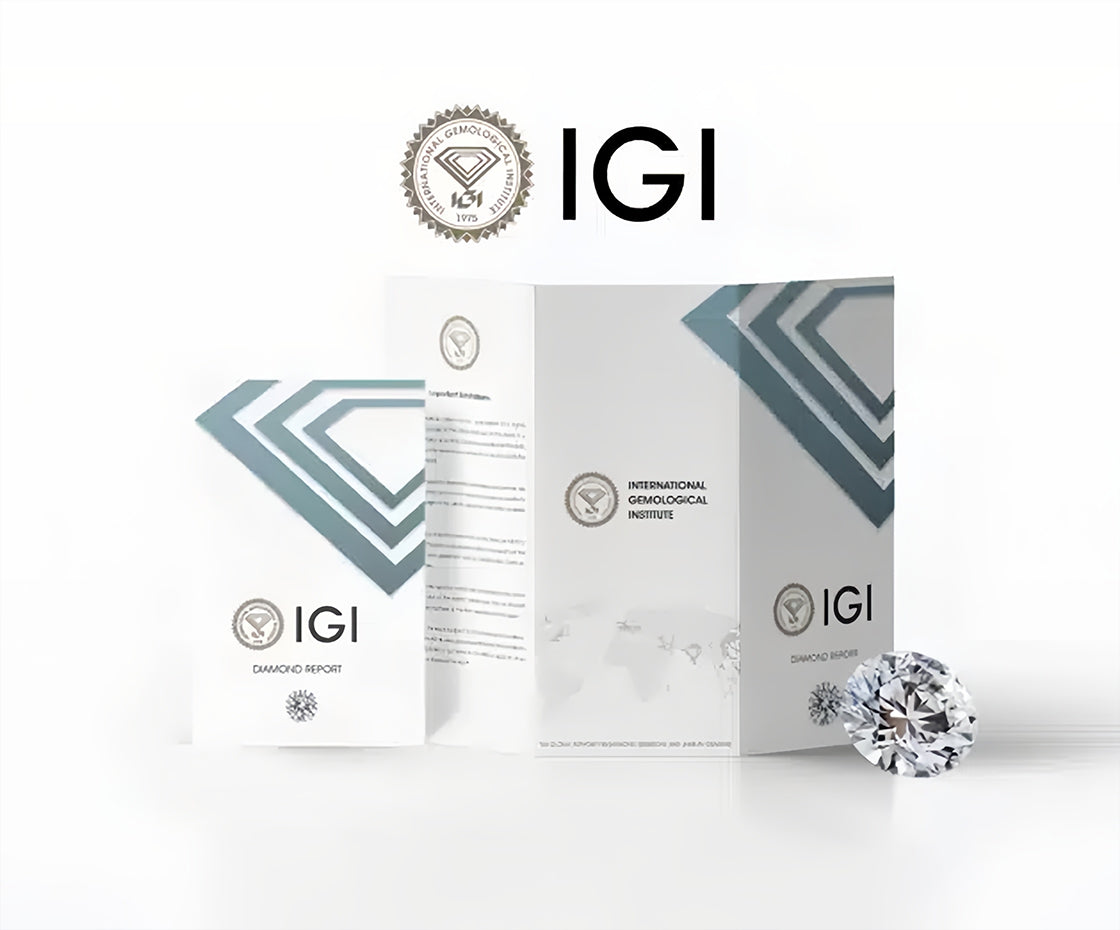
An IGI lab-grown diamond report is an official document that verifies a diamond’s identity and quality. It’s issued after the diamond is graded under strict lab conditions, evaluating its 4Cs (cut, color, clarity, carat), growth method, and more.
IGI issues reports for natural diamonds, lab-grown diamonds and finished jewelry. Read the report for the item you plan to buy.[R12]
You may see this document called an “IGI certificate.” IGI uses the term grading report. Read its title first so you know whether it describes a loose diamond or a finished piece of jewelry. [R12]
What’s Inside an IGI Report?
Here’s what you’ll typically find in a certified IGI lab-grown diamond grading report:
1. Identification Info
- Report Number – A unique ID you can verify online
- Date of Issue – When the grading was done
- Shape and Cutting Style – E.g. Round Brilliant, Oval Modified Brilliant
You can verify your diamond’s report on IGI's website here.
2. The 4Cs: Carat, Color, Clarity, and Cut
This is the heart of your diamond’s identity.
- Carat Weight: The diamond’s weight in carats. One carat equals 200 milligrams. Use the measurements field to check its size in millimeters.[R5]
- Color Grade: For diamonds in the D-to-Z range, D means colorless and Z means light yellow or brown. Read the grade on the actual report.[R1]
- Clarity Grade: Describes internal and surface features assessed at 10× magnification. Check the grade and close-up views of your selected diamond.[R2]
- Cut Grade: Read the overall cut grade where one is provided. Review the diamond’s proportions, finish and appearance together.[R4]
3. Additional Grading Details
- Polish: Surface finish. “Excellent” is best.
- Symmetry: Alignment of facets. You want “Excellent” or “Very Good.”
- Fluorescence: Describes the diamond’s response to UV light. Compare how the stone looks in normal lighting instead of choosing by this field alone.[R10]
4. Proportions Diagram
This section shows your diamond’s physical measurements and proportions:
- Table % and Depth % – These affect light performance.
- Crown and Pavilion Angles – The angles of the top and bottom of the diamond.
- Girdle and Culet – Edge thickness and bottom point.
Tip: Depth alone does not predict sparkle. Compare proportions and cut information with photos or video of the actual diamond.[R4]
5. Clarity Plot & Comments
If your report includes a clarity plot, use its symbols to locate the features shown. Read the plot with the clarity grade and comments.[R1]
- Symbols show the type of inclusion: feather, crystal, pinpoint, etc.
- Growth Method: CVD and HPHT are diamond growth methods. Read any growth and treatment comments included on your report. Ask the issuer if the information you need is missing.[R2]
6. The Inscription
Most IGI-certified lab-grown diamonds come laser-inscribed with the report number right on the girdle (the edge of the diamond). This helps match the physical stone to its paperwork.
Check it using a 10x loupe or ask your jeweler to show it to you.

Read the Measurements and Comments
Carat weight tells you how much the diamond weighs. Measurements tell you its length, width and depth in millimeters. Two diamonds with the same carat weight can have different face-up sizes. Compare the same shape when you review dimensions. [R5]
The girdle is the outer edge between the crown and pavilion. Its thickness appears in the proportions information where supplied. It is also where a report number may be inscribed. Check this field with the rest of the proportions, rather than using one number to choose the stone. [R1] [R4]
Use our millimeter and carat guide to understand how size and weight differ. A size chart gives an estimate. The measurements and weight on the actual report describe the graded diamond.
CVD and HPHT describe how a diamond grows. Post-growth treatment happens after growth. Read the exact comments on your report. If a growth method or treatment statement is absent, ask what information the report service includes. [R2]
Verify an IGI Report Online
Use the official IGI Verify Your Report page. Start from IGI’s own website if you are unsure about a link. [R1]
1. Enter the report number exactly as it appears on the document.
2. Compare the online result with your copy. Check the report type, shape, weight, measurements and available grades.
3. Read the origin description and comments. Make sure you are looking at the correct diamond or jewelry report.
4. If the diamond has a report-number inscription, ask your jeweler to show it under magnification. Compare the number with the document.
5. If a number cannot be found or details differ, ask the seller and IGI to check the issue before relying on the document.
An online match checks the record. It does not test the stone in your hand. GIA has documented a case in which a non-diamond stone carried a false inscription linked to a real report number. Use the inscription with other identifying details, and seek a professional check if needed. [R9]
| Document | What it describes | What to check |
|---|---|---|
| Loose diamond grading report | The individual diamond examined by the laboratory. | Report number, origin, weight, measurements and grading details. |
| Finished jewelry report | The submitted piece, its stones and relevant mounting details. | Which stones were assessed and whether the setting limits the grades. |
| Jewelry appraisal | A description of the item plus a value for the stated appraisal purpose. | The purpose, valuation date and requirements of the intended insurer or recipient. |
An IGI jewelry report may say “graded as mounting permits.” This means the setting limits the assessment. Color and clarity may appear as ranges, such as D–E or SI1–SI2. If the diamond was graded before mounting, the report may state that instead. [R3]
An IGI finished jewelry report is one report type. Do not assume that a finished-jewelry document from a different issuer uses the same methods or covers the same details. Read the issuer’s name, scope and findings.

What You Really Need to Check
When reading your report, here are the six things we recommend checking:
- Cut Grade – A “Very Good” cut or better = sparkle you’ll notice.
- Color – D to H offers that crisp, white look.
- Clarity – Stick with VVS or VS—eye-clean and brilliant (we’ve done that part for you).
- Fluorescence – “None” or “Faint” is best unless you're after a very specific look.
- Growth Method & Comments – Look for untreated CVD or HPHT.
- Laser Inscription – Confirms that the diamond matches the report.
Single Diamond Weight and Total Carat Weight
Total carat weight, often written as CTW, is the combined weight of the diamonds included in that total. It does not tell you the weight of each stone or the number of individual grading reports. Check whether the listed total covers one earring, a pair or the whole piece.
| Teaching example | Weight per diamond | Combined weight |
|---|---|---|
| Two diamonds | 0.50 ct each | 1.00 CTW |
| Ten diamonds | 0.10 ct each | 1.00 CTW |
Both examples total 1.00 CTW, but their individual stone weights differ. These are math examples, not specifications for a Leonids product. A store’s policy based on single-diamond weight cannot be applied to CTW alone.
- Diamond studs: Check whether each main diamond has its own report, and which report belongs to which stone.
- Single-stone and two-stone pendants: Check each main diamond’s weight and report details separately.
- Promise rings and cluster rings: Separate the center diamond’s weight from the combined weight of smaller stones.
- Hoops, tennis bracelets and tennis necklaces: Ask what the supplied documents cover. A high CTW does not establish that every small diamond has an individual report.
Reports Included With a Leonids Order
At Leonids, our current FAQ states that we provide an IGI report for each single diamond weighing 0.5 carat or more. Small accent diamonds do not all have separate reports. This is our document policy, not a universal IGI weight rule. [R11]
Our FAQ also states that a piece with a center stone under 0.5 carat receives an AGL finished-jewelry certificate. Before ordering, check the issuer and document coverage for your selected piece. [R11]
We make each piece after the order is placed. The final IGI report number is not available before checkout. We provide certificate details after the order ships. A sample report helps you learn the format; it is not the report for your order. [R11]
Before you buy, confirm the weight of each main diamond, the number and type of documents included, and how each document matches your chosen item. Start with our report policy and the specifications for your selected option.
What a Grading Report Does Not Promise
A grading report describes the item the laboratory examined. An appraisal has a separate purpose and may include a replacement value. Neither document guarantees a future selling price. If you need insurance, ask your insurer which documents it requires. [R8] [R12]
A diamond report also does not replace a check of the finished setting, clasp, fit or condition. Review the jewelry specifications as well as the stone’s report.
Why IGI Over GIA for Lab-Grown Diamonds?
Here’s a quick comparison:
| Feature | IGI | GIA |
|---|---|---|
| Focus | Natural & Lab-Grown | Primarily Natural |
| Cut Grade Included? | Yes | Not always for lab-grown |
| Clarity Consistency | High | Very High |
| Turnaround Time | Fast | Slower |
Note: Choose a report by the information it provides about the diamond or jewelry item you are buying. [R12]
References
Sources checked on September 21, 2026. Undated service pages describe the information available on that date. The 2020 and 2023 sources below provide background examples, not current market statistics.
[R1] International Gemological Institute. How to Read an IGI Diamond Grading Report Like a Pro. July 7, 2025. Accessed September 21, 2026.
[R2] International Gemological Institute. Lab Grown Diamond Report and Services. No publication date shown. Accessed September 21, 2026.
[R3] International Gemological Institute. Jewelry Reports. No publication date shown. Accessed September 21, 2026.
[R4] International Gemological Institute. Diamond Cut Grading. No publication date shown. Accessed September 21, 2026.
[R5] Gemological Institute of America. Diamond Carat Weight. No publication date shown. Accessed September 21, 2026.
[R6] Gemological Institute of America. Laboratory-Grown Diamond Services. Current service page; no publication date shown. Accessed September 21, 2026.
[R7] Gemological Institute of America. Laboratory-Grown Diamond Services US Dollar Fee Schedule. Effective July 1, 2026; see page 1. Accessed September 21, 2026.
[R8] International Gemological Institute. IGI Gem and Jewelry Appraisal Services. No publication date shown. Accessed September 21, 2026.
[R9] Sicebiso Hlatshwayo and Sally Eaton-Magaña. Synthetic Moissanite with Fraudulent GIA Inscription. Gems & Gemology, Fall 2020; historical laboratory case. Accessed September 21, 2026.
[R10] Gemological Institute of America. Is Diamond Fluorescence Good or Bad. July 18, 2023; background explanation. Accessed September 21, 2026.
[R11] Leonids Jewelry. FAQs. Current store policy; no publication date shown. Accessed September 21, 2026.
[R12] International Gemological Institute. IGI Reports. No publication date shown. Accessed September 21, 2026.
About the Author: This guide was written by Oggi, our jewelry expert. She has over 10 years of experience in precious metals and gemology.
Our team regularly consults with master jewelers and metallurgists to ensure we provide the most accurate, up-to-date information on jewelry metals and trends.
Last Updated: September 21, 2026
Shop IGI-graded Diamond Jewelry


FAQs
Go to igi.org/verify-your-report and enter the report number.
HPHT and CVD are ways to grow diamonds in a lab. HPHT uses high pressure and heat. CVD grows diamond from a carbon-containing gas. Check your report’s comments for any growth information provided.[R2]
Check the number on your document and use IGI’s official website. If you still cannot find it, ask the seller and IGI to confirm the record. A failed lookup alone does not explain the cause.
No. The lookup checks the laboratory record. Compare the stone’s measurements and identifying details too. A qualified gemologist can help resolve a mismatch. [R9]
Report coverage depends on the documents supplied for that item. Check the weight of each main diamond and the document policy. Total carat weight does not establish how many individual reports are included. [R11]
A setting can limit the view of a diamond. An IGI report marked “graded as mounting permits” may use ranges for color and clarity. Read the report’s wording to see how the assessment was made. [R3]
No. CVD names a growth method. It does not by itself tell you whether treatment followed. Read the report’s comments and ask the issuer about missing details. [R2]
Our current FAQ says the final number is provided after the order ships. Before purchase, you can review a sample report and confirm the documents included with your selected piece. [R11]
Ask your insurer what it needs. A grading report records gem details. An appraisal may include a value for a stated purpose. They are different documents. [R8]

Free US Shipping

Free One-year Warranty

IGl-Certified Diamonds

Free Ring Resizing

30-Day Free Return

We focus on IGI certified lab grown diamonds, & offer a variety of gemstone options for customers with limited budgets. Pieces are crafted in solid gold 10K~18K or platinum, custom design available. Orders are supported by resizing, warranty, returns, & international shipping services.

- Choosing a selection results in a full page refresh.
- Opens in a new window.