How to Choose an Asscher Cut Diamond: Pros, Cons & 1–3 Carat Size Chart
Quick Answer: The best Asscher cut diamond balances an attractive hall of mirrors effect, a clean-looking center, and face-up dimensions that suit your hand—not simply the highest carat weight. Look for even step-cut reflections, compare 1, 2, and 3 carat sizes in millimeters, and choose a setting that fits your style and daily routine. Before buying online, confirm the listed specifications, what the product images represent, the certification process, and the return terms.
Asscher diamonds attract shoppers who want distinctive geometry rather than constant glitter. But will a 2 carat stone look smaller than expected? Are inclusions more visible? This guide answers those questions with Leonids product comparisons.
Asscher Cut Pros and Cons: Is It Right for You?
Developed by Joseph Asscher in 1902, the original Asscher cut has a square outline, cropped corners, and orderly step-cut facets. These create broad, layered flashes of light—often called the hall of mirrors effect—rather than the fast, scattered sparkle of a round brilliant cut. That difference is a matter of taste, not automatically a difference in diamond quality.
Royal Asscher is a separate proprietary 74-facet design, not a requirement for classic Art Deco beauty.
|
Pros |
Cons |
|
Distinctive square shape and Art Deco style |
Less rapid sparkle than many brilliant cuts |
|
Elegant mirror-like reflections |
Some inclusions can be easier to see |
|
Works with minimalist and vintage settings |
Can look compact for its carat weight |
|
Uncommon appearance compared with round or oval |
Actual light performance deserves close inspection |
Who is it for? Choose an Asscher if you enjoy architectural details, balanced geometry, and sophisticated reflections. For more glitter, compare radiant or round diamonds. Emerald cuts offer similar step-cut reflections in a more elongated outline.
How to Choose a Good Asscher Cut Diamond
1. Look for Balanced Light Performance
An Asscher produces broad flashes and contrasting bands as it moves. Some show a windmill-like center pattern; healthy contrast matters more than an entirely bright face.
To assess light performance, view the diamond straight on and at several angles. Look for moving reflections, balanced corners, and no persistently dull section. Compare videos under similar lighting, not differently edited photos.
A product description such as “Excellent” may be useful, but no single label tells the whole story. How the diamond actually looks is what you will appreciate every day. If you compare two videos, keep the camera distance and lighting as consistent as possible. A stone filmed under bright spotlights may look more dramatic even when the difference comes from the room rather than the diamond.
2. Understand Clarity and Color Without Inventing a Perfect Grade
Because step cut diamonds have broader, less visually busy facets, inclusions may be more noticeable than in some brilliant cuts. Check whether marks are visible in the center when the diamond is viewed at a realistic size. The aim is an attractive, clean-looking appearance, not paying for a grade you cannot distinguish by eye.
Leonids' Asscher product listings for Thea, Rhea, Nova, Brielle, and Loretta state VS clarity and D–E color. These are published product specifications. They should not be confused with a promise that shoppers can independently select individual clarity subgrades for each design. For made-to-order jewelry, it is especially helpful to distinguish an advertised average specification from the grading information that accompanies the completed order. Ask what is guaranteed for your selection and what is representative of the model.
White gold and platinum create a crisp look; yellow or rose gold add vintage warmth. Choose metal for your preferred style.
3. Check Shape, Symmetry, and the Information Actually Provided
Compare the cropped corners, square outline, and central symmetry. Even stones of equal weight can look different on the hand.
Review the information that the jeweler publishes: center-stone carat weight, measurements, color and clarity descriptions, certification, and setting specifications. Leonids also lists an Excellent cut description on the product pages; ask what grading information supports that description rather than treating it as a universal guarantee of visual performance.
Prioritize realistic dimensions, visible appearance, and clear documentation.
Asscher Cut Diamond Size Chart: 1 vs. 2 vs. 3 Carats
Do Asscher Cut Diamonds Look Smaller?
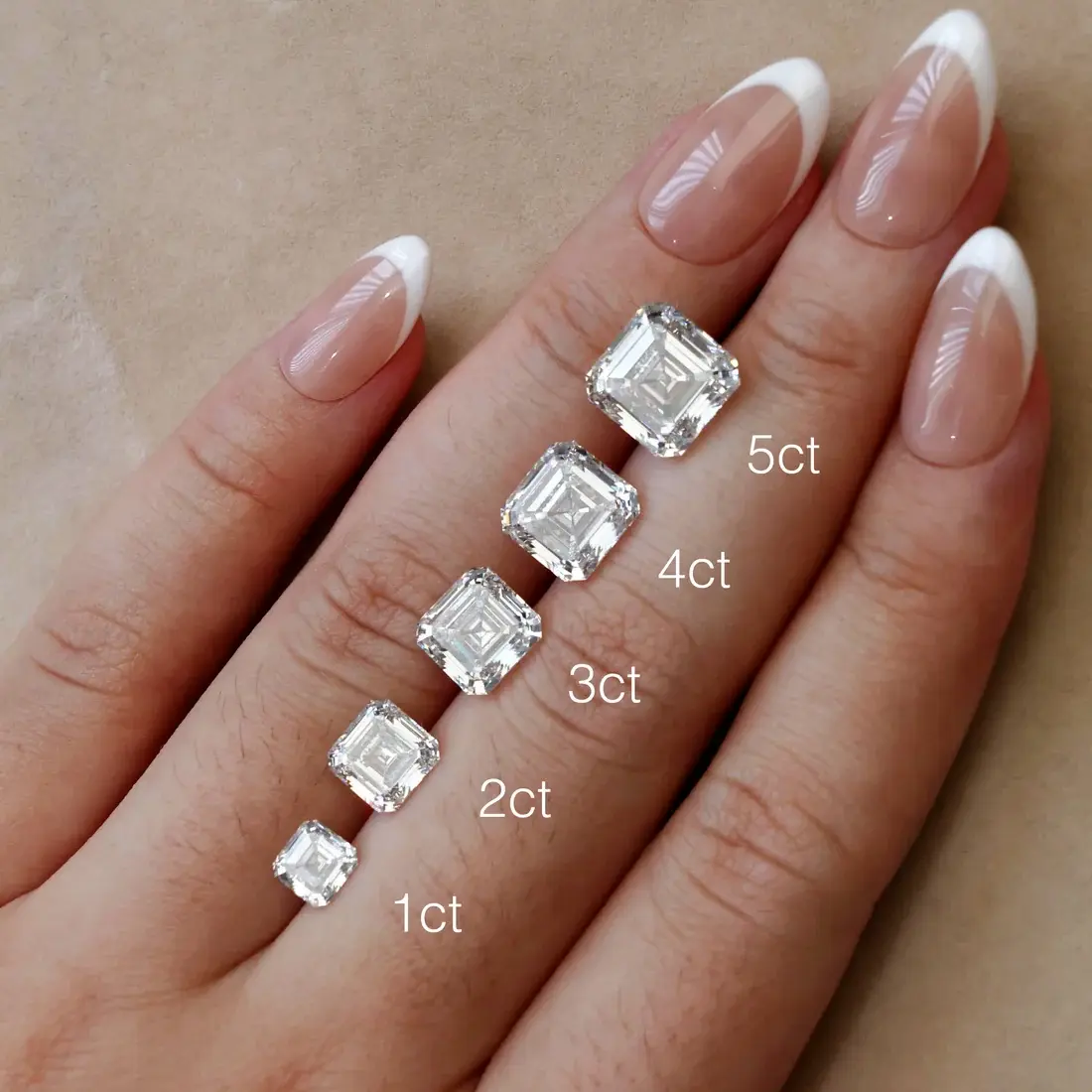
They sometimes do. Carat measures weight, not physical width. Its compact square outline can appear smaller than an elongated diamond of the same weight, making millimeter comparisons especially useful.
These are the reference measurements currently published on selected Leonids Asscher product pages:
|
Carat Weight |
Thea, Rhea, Nova & Brielle |
Loretta |
|
1 carat |
5.6 × 5.6 mm |
5.5 × 5.5 mm |
|
2 carats |
6.9 × 6.9 mm |
7.0 × 7.0 mm |
|
3 carats |
7.9 × 7.9 mm |
8.0 × 8.0 mm |
These are product reference sizes, not universal measurements or guaranteed dimensions for every individual diamond. Check the selected design's current specifications before purchase.
1 carat: understated. Choose 1 carat for a delicate look that still highlights the geometric pattern.
2 carats: balanced. The 2 carat option works for shoppers who want a noticeable square center without an especially bold look. Using Thea's published examples, the reference width increases from 5.6 mm at 1 carat to 6.9 mm at 2 carats. Doubling the weight does not double the width.
3 carats: statement-making. Choose 3 carats for stronger visual presence; examine the setting height and band proportions.
Your finger size and band width change how large each carat size appears. For a meaningful comparison, use photographs taken on the same hand with the same camera scale and similar settings. Images that are independently zoomed cannot reliably show relative size. A practical approach is to compare the square millimeter outlines on a ruler or printed template, then consider how wide the band appears beside the center. This gives you a better sense of coverage before judging styled photographs.
What Setting Works Best for an Asscher Engagement Ring?
An Asscher's straight lines can look elegant with a simple band or more romantic with extra accents. A solitaire-inspired design keeps the center stone as the focal point. Pavé diamonds add sparkle along the band, while a hidden halo or detailed basket brings interest from the side. These accents do not change the center diamond's own light performance.
Check height, corner protection, cleaning access, and wedding-band fit before prioritizing decorative details.
Comparing Leonids Thea, Rhea, Nova, and Loretta
Thea Pavé Solitaire features a pavé band, hidden halo, and elevated cathedral-style profile. It suits buyers who like a classic silhouette with additional sparkle.
Rhea Basket Setting has delicate basket details and a slender band. Nova Twisted Band uses an intertwined shank and pavé accents for a more flowing, romantic look. Loretta Hidden Accent offers a cleaner, solitaire-inspired appearance with four small round accents tucked beneath the center.
|
Feature |
Rhea |
Nova |
|
Design focus |
Decorative pavé basket |
Intertwined pavé band |
|
Published band width |
1.21 mm |
1.67 mm |
|
Listed 3 carat center size |
7.9 × 7.9 mm |
7.9 × 7.9 mm |
|
Best style match |
Delicate, vintage-inspired detail |
Fuller, romantic band shape |
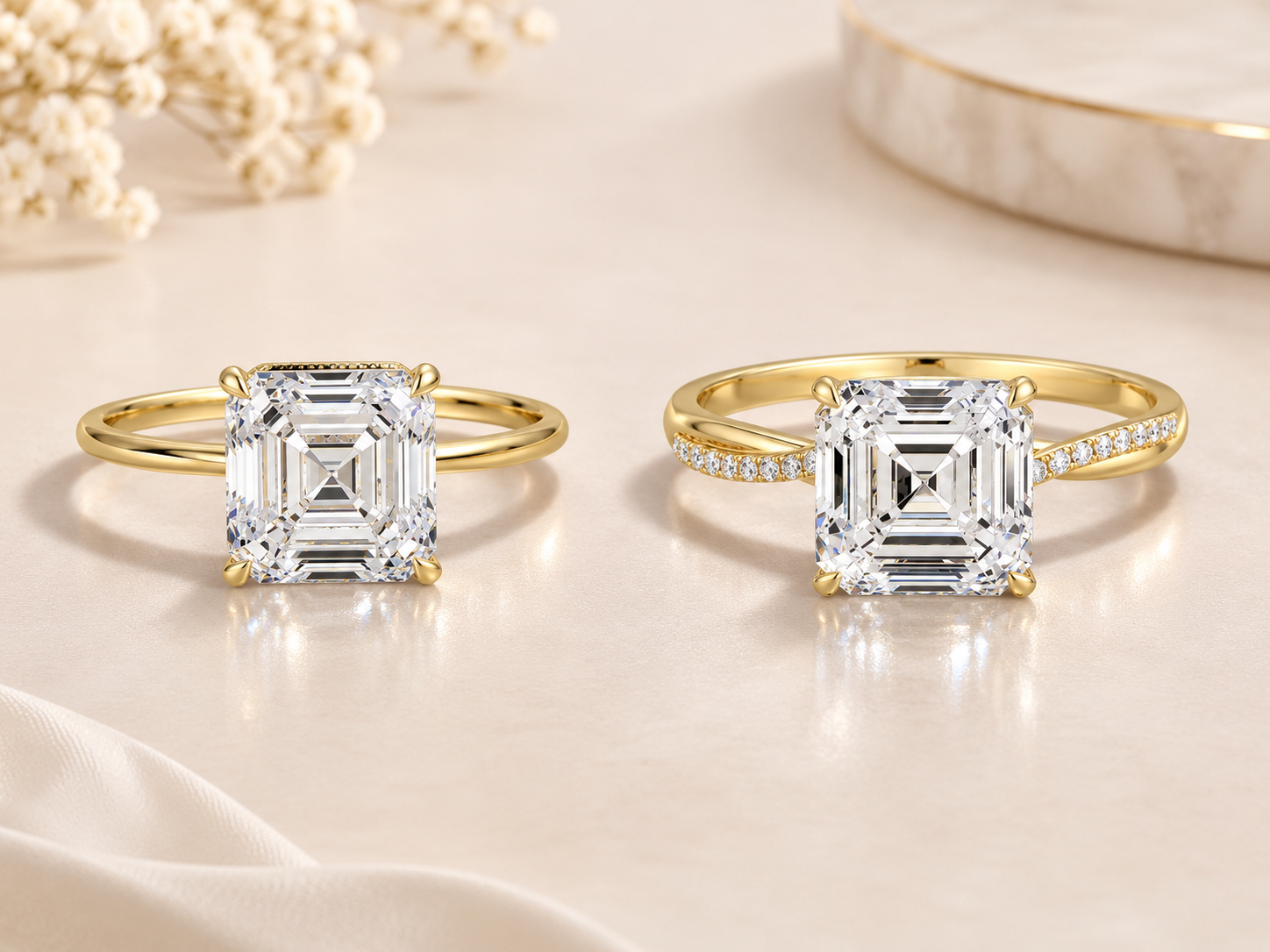
Choose Rhea for delicate basket detail, or Nova for a fuller curved band. Width alone cannot establish durability; check thickness, prong security, maintenance, and resizing.
Are Lab-Grown Asscher Diamonds Worth Buying?
Lab-created diamonds are real diamonds with essentially the same chemical, physical, and optical properties as mined diamonds. They generally cost less than comparable natural stones, giving buyers more flexibility to choose a preferred carat size, setting, or metal within their budget.
An Asscher that looks balanced and appealing is often a better purchase than a heavier stone chosen only for its weight. Compare the ring's total price and specifications, not just the center carat. Resale value is not guaranteed; buy for long-term enjoyment, not investment returns.
For more diamond shapes and setting styles, browse Leonids' lab-grown diamond engagement rings.
What Should You Check Before Buying an Asscher Cut Online?
Before checkout, confirm:
|
Checkpoint |
What to Confirm |
|
Diamond |
Center-stone weight, millimeter measurements, listed VS clarity and D–E color |
|
Images |
Which carat size is pictured and whether images show a reference design |
|
Setting |
Metal choice, band dimensions, ring size, height, and prong details |
|
Certification |
Available sample documents and when the final report information arrives |
|
Order |
Production time, shipping estimate, resizing, warranty, and return eligibility |
Product images may not represent the exact diamond you will receive. Since Leonids makes many engagement rings after an order is placed, pictures and videos can illustrate the design and a photographed carat size rather than the final center stone. For example, Thea's 1 carat listing shows a 1 carat diamond, while Rhea and Nova's featured listings show 3 carat versions. Check the photograph notes for your chosen design.
Leonids states that individual diamonds weighing at least 0.5 carat receive an IGI report. Customers can review sample certificates before buying, while the final report number is supplied after shipment. Confirm any questions with the jeweler before placing your order.
The published US policy allows eligible standard, non-customized orders to be returned within 30 days of delivery, subject to conditions. Engraved or specially modified orders are final sale, and return shipping is the customer's responsibility. Read the latest official policy before checkout. Allow for production time plus shipping before your proposal.
3 Mistakes to Avoid When Buying an Asscher Cut Diamond
1. Judging size by carats alone. Compare millimeter dimensions and correctly scaled on-hand photographs instead of expecting a 2 carat Asscher to look twice as wide as a 1 carat stone.
2. Expecting round-diamond sparkle. Asscher diamonds are known for broad, changing mirror-like reflections. Choose that appearance because you enjoy it, not because you expect the fastest glitter.
3. Ignoring the details of a made-to-order purchase. Confirm the pictured carat size, actual specifications, ring fit, delivery timing, and return eligibility before paying.
Find the Right Asscher Cut Diamond for Your Style
A good Asscher engagement ring combines geometric beauty, pleasing light performance, realistic dimensions, and a setting you will enjoy wearing. Start with the look you love, compare the published specifications, and choose a ring that fits your lifestyle and budget.
Explore Leonids' Asscher cut engagement rings to compare lab-grown designs, 1–3 carat sizes, metals, and settings.
Share