How to Choose an Oval Lab-Grown Diamond Engagement Ring: Pros, Cons & Buying Guide
Quick Answer: How Do You Choose an Oval Lab-Grown Diamond Engagement Ring?
Choose an oval lab-grown diamond engagement ring by checking its bow tie effect, length-to-width ratio, actual dimensions, and light performance before focusing on carat weight. Look for balanced proportions, attractive sparkle, eye-clean clarity, and a secure setting suited to your lifestyle. Compare certification, total price, and purchase terms before ordering. The best oval diamond ring balances beauty, quality, comfort, and personal preferences.
Oval diamonds combine elongated elegance, rounded edges, and brilliance. They can appear larger face-up than round diamonds of the same carat weight. Yet similar grades can produce different looks. This oval diamond buying guide explains quality, sizes, settings, and common mistakes.
Is an Oval Lab-Grown Diamond Engagement Ring Right for You?
An oval cut diamond combines round brilliant sparkle with an elongated outline that can make fingers appear longer. Its rounded edges avoid sharp tips.
|
Advantages |
Things to Consider |
|
Elegant, elongated silhouette |
Some stones show a noticeable bow tie effect |
|
Often looks larger than a round diamond of the same carat weight |
Proportions and light performance vary |
|
Rounded edges without sharp tips |
Exposed edges still need protection |
|
Complements classic and unusual settings |
Height and design affect comfort |
|
Lab-grown choices offer budget flexibility |
A certificate cannot guarantee visual beauty |
Who should choose an oval? Choose oval for graceful proportions and finger coverage; choose round brilliant if you prefer circular symmetry and more standardized cut evaluation.
What Are the Best Tips for Choosing an Oval Lab-Grown Diamond?
Look for balanced brilliance, appealing shape, and dimensions that suit your ring design.
1. Check the Bow Tie Effect and Overall Sparkle
The bow tie effect creates darker areas across the center of some oval diamonds. It relates to faceting and viewing conditions. Subtle contrast is normal; a consistently dark center may appear less lively.
When comparing stones:
· Look for sparkle across the center and rounded ends.
· Notice whether the dark area changes as the diamond moves.
· Be cautious of a persistently dark or dull center.
· Review an actual-stone video when one is available.
For made-to-order rings, ask about available visual references and selection standards. Ask whether lighting and imagery represent the actual ordered stone rather than a sample.
Buying tip: Prioritize balanced light performance. Neither a particular depth percentage nor a claim of “no bow tie” guarantees a beautiful stone.
2. Choose the Right Length-to-Width Ratio
The length-to-width ratio (L/W ratio) describes an oval diamond's outline. Divide length by width: a 10.0 × 7.0 mm diamond has an L/W ratio of approximately 1.43.
|
L/W Ratio |
Overall Appearance |
Best For |
|
1.30 |
Fuller, wider oval |
Soft, rounded silhouette |
|
1.40 |
Balanced oval |
Classic elegance |
|
1.50 |
Longer, narrower oval |
Slender, elongated appearance |
IGI's Excellent Cut criteria for oval brilliant diamonds include an L/W ratio of 1.35–1.50, among other conditions. Your preference still matters. Check for uneven curves, bulging shoulders, or overly narrow ends. A wider oval may look softer; a longer oval creates a more dramatic silhouette.
3. Compare Carat Weight and Actual Diamond Size
Carat weight measures mass, not visible size. Two oval diamonds of the same carat can differ in length, width, depth, and face-up surface area. A deeper stone may hold more weight below the visible surface.
Leonids Melina Oval Diamond Size Reference
|
Carat Weight |
Reference Dimensions |
Visual Impression |
|
1 Carat |
7.5 × 5.5 mm |
Delicate and understated |
|
2 Carat |
10.0 × 7.0 mm |
Noticeable yet balanced |
|
3 Carat |
12.0 × 8.0 mm |
Bold statement look |
These are published references for the Melina design, not universal diamond measurements. Actual stones can vary.
One carat looks understated; 2 carats offers more coverage; 3 carats creates bolder impact. Consider comfort and finger size too. Use similarly scaled product photographs so camera angles do not distort comparisons.
Real Product Comparison: Melina vs. Delilah
|
Feature |
Melina 2CT |
Delilah 2CT |
|
Center Stone |
Oval lab-grown diamond |
Oval lab-grown diamond |
|
Reference Size |
10.0 × 7.0 mm |
10.0 × 7.2 mm |
|
L/W Ratio |
1.43 |
1.39 |
|
Setting |
Cathedral, pavé, hidden halo |
Cathedral, floral clusters |
|
Design Style |
Refined, vintage-inspired |
Romantic, nature-inspired |
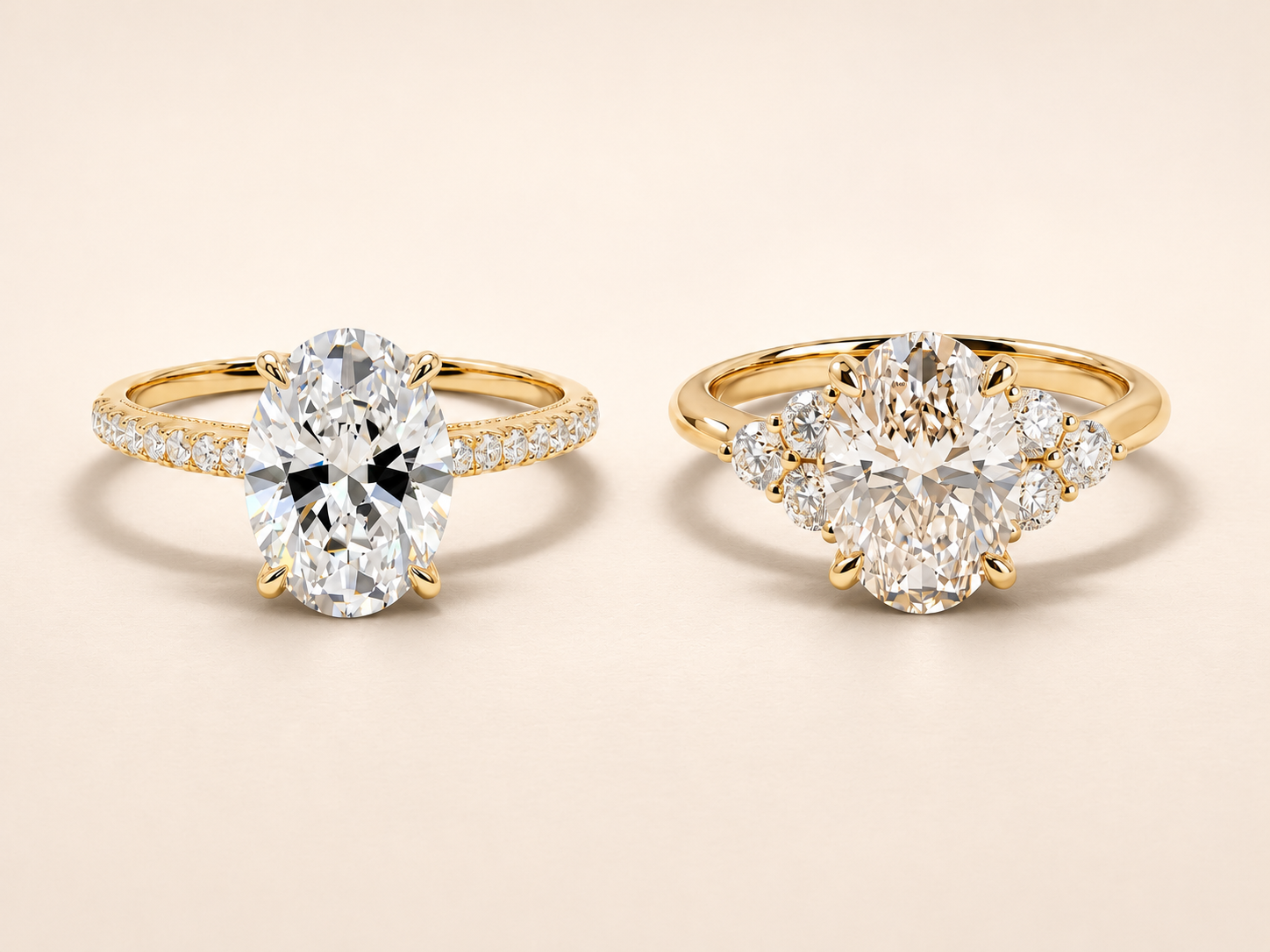
Both feature 2-carat oval center stones. Melina's ratio is slightly more elongated, while Delilah's floral clusters look fuller. Their 0.2 mm width difference is subtle; setting design may matter more on the hand.
Compare the Melina 2CT Oval Engagement Ring and Delilah Floral Cluster Engagement Ring to see how different settings complement the same diamond shape.
Reference dimensions do not establish that either diamond has better sparkle or cut quality.
4. Evaluate Cut Quality, Depth, and Symmetry
Cut quality affects light return. GIA does not assign its standard overall cut grade to ovals, though it reports polish and symmetry. See the GIA Oval Cut Diamond Guide for visual considerations.
IGI offers cut grading for eligible fancy-shaped diamonds, including oval brilliant cuts. Diamond cutters must balance shape appeal, proportions, and light performance when working with rough material.
IGI Oval Brilliant Excellent Cut References
|
Measurement |
Excellent Cut Reference |
|
Length-to-Width Ratio |
1.35–1.50 |
|
Total Depth |
58%–63% |
|
Table Percentage |
56%–62% |
IGI also considers other measurements, polish, symmetry, bow tie visibility, and visual appearance. Meeting these ranges alone does not guarantee beauty.
Buying tip: Use recommended proportions to narrow your options, then examine the outline, shoulder symmetry, brilliance, and any distracting dark areas. See the IGI Fancy Shape Cut Grading Guidelines for the technical criteria.
5. Balance Color, Clarity, and IGI Certification
Clarity describes inclusions; color grades describe body color. Eye-clean clarity usually matters more than chasing the highest grade. VS diamonds can balance quality and value; VVS appeals to those wanting higher specifications. Check inclusion visibility and location.
G–H diamonds can appear bright and near-colorless, while D–F are higher color grades. Some oval diamonds show warmth near their rounded ends, so consider the overall appearance with your chosen metal.
When comparing diamonds, prioritize:
· Clarity: Inclusions that do not distract the naked eye.
· Color: A look that complements your metal and preferences.
· Cut quality: Lively sparkle and balanced proportions.
· Certification: Independent documentation of diamond characteristics.
Leonids offers configurations including D–E color and VS–VVS clarity, depending on product. Made-to-order shoppers can review sample IGI reports before purchase; final report details follow shipment for eligible diamonds. Reports cannot replace visual assessment.
Which Oval Engagement Ring Setting Should You Choose?
The setting shapes the center stone's appearance and influences protection, cleaning, and comfort.
|
Setting Style |
Best For |
What to Consider |
|
Solitaire |
Timeless minimalism |
Prong security and diamond visibility |
|
Hidden Halo |
Subtle added sparkle |
Setting height and cleaning access |
|
Three-Stone |
Balanced, symbolic style |
Side-stone proportions |
|
Floral / Cluster |
Romantic individuality |
Accent-stone maintenance |
|
Bezel |
Smooth, modern appearance |
Metal coverage and protection |
|
East-West |
Unconventional style |
Horizontal finger coverage |
Prongs expose more diamond; bezels protect edges. Thin bands emphasize the stone; broad bands create a bolder look.
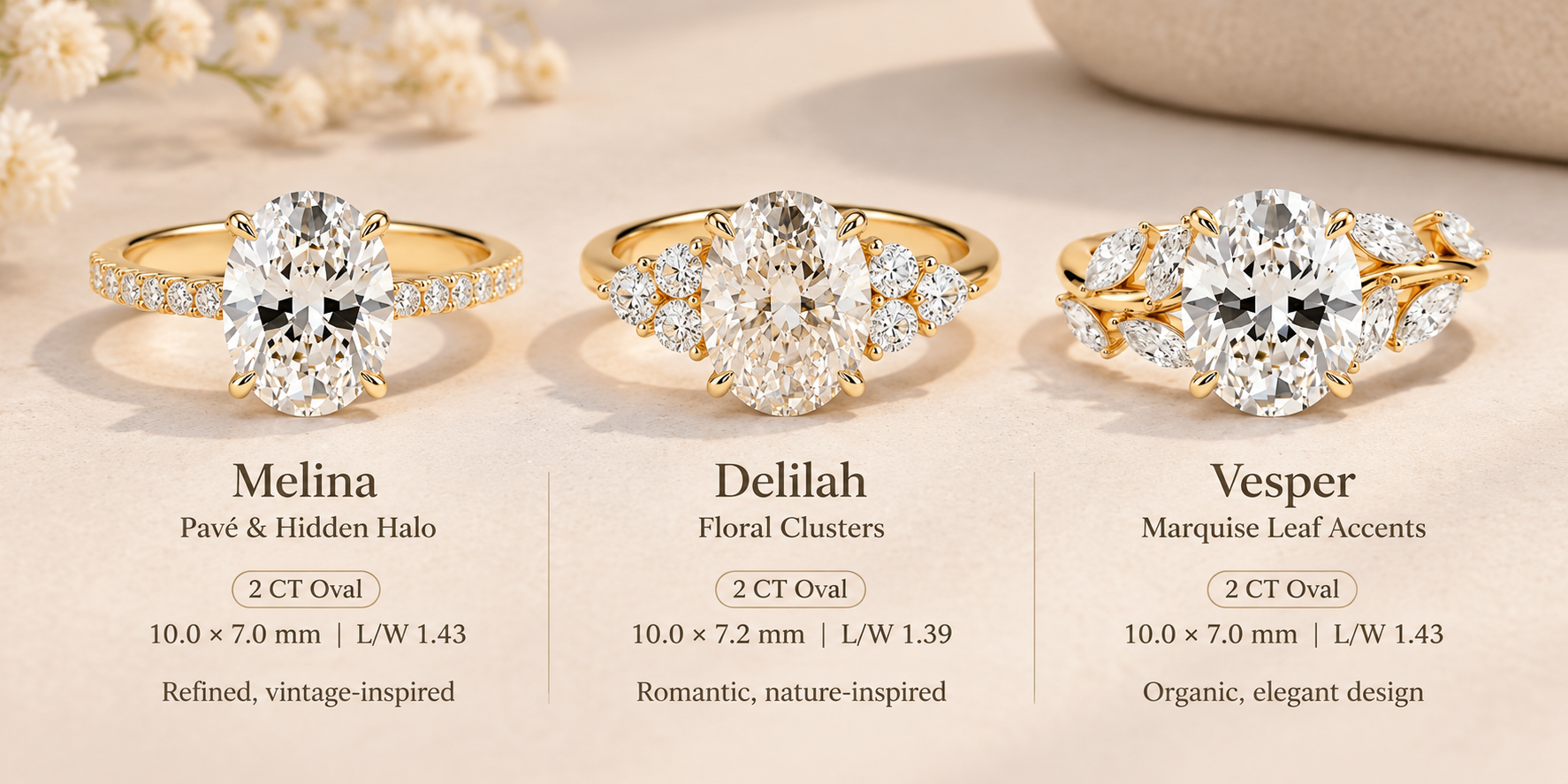
Three Leonids designs to consider:
Melina: A vintage-inspired cathedral ring with double-row pavé, milgrain accents, and a hidden halo—suited to refined elegance with added sparkle.
Vesper: Marquise diamond accents follow a leaf-inspired band, offering an organic, nature-inspired style.
Delilah: Floral diamond clusters surround the oval center stone for a fuller, romantic silhouette.
Choose a setting that balances appearance and practicality. If you work with your hands or frequently wear gloves, pay special attention to prongs and height. If you love intricate details, consider how easily you can clean around the center and accent stones.
Are Oval Lab-Grown Diamond Engagement Rings Good Value for Money?
Lab-grown diamonds have essentially the same chemical composition and physical and optical properties as natural diamonds, but are created in a controlled environment. They can give buyers more flexibility in carat size and quality for a set budget.
Value is not simply size or price. Finished cost reflects the center stone, metal, accents, craftsmanship, and customization. Compare finished rings with similar specifications rather than assuming oval costs less than round.
Smart buying strategy: Start with your total ring budget and rank your priorities. If visual size matters most, compare face-up measurements instead of paying only for extra carat weight. If you love a floral or hidden halo setting, reserve budget for its design details and accent diamonds. Rather than automatically paying more for VVS clarity, consider an attractive, eye-clean VS center stone and a setting you will enjoy wearing daily.
If you are comparing shapes beyond oval, explore Leonids Lab-Grown Diamond Engagement Rings.
Are Oval Engagement Rings Suitable for Everyday Wear?
Yes, if securely set and maintained. Ovals lack the sharp tips of pear and marquise diamonds, but exposed edges can still chip.
What Affects Comfort and Durability?
Consider the setting height, prong arrangement, band width, and your routine. Higher settings can snag clothing; lower profiles may be more convenient for active wearers. Pavé and cluster settings may need extra cleaning and regular inspection of accent stones.
Can You Pair an Oval Engagement Ring With a Wedding Band?
Yes, but the fit depends on the design. A raised cathedral may accommodate a straight wedding band, while a lower or decorative setting might need a curved or contour band. Confirm the fit if you want both rings to sit flush.
What Should You Check Before Buying an Oval Engagement Ring Online?
Before buying online, verify more than the product photos. Make sure you understand which specifications are guaranteed for the ordered ring and which measurements are examples, especially when selecting a made-to-order center stone:
|
Buying Checkpoint |
What to Verify |
|
Diamond Appearance |
Sparkle, bow tie, available visual references |
|
Diamond Size |
Carat weight and actual measurements |
|
Diamond Quality |
Color, clarity, proportions, grading information |
|
Certification |
Diamond origin and IGI grading process |
|
Ring Construction |
Metal, prongs, band width, setting height |
|
Ring Fit |
US size and resizing eligibility |
|
Purchase Terms |
Production, delivery, warranty, returns |
Verify Diamond Details and Certification
For a made-to-order ring, confirm advertised specifications and the jeweler's selection standards. Leonids provides sample IGI certificate information before purchase and final grading details after shipment for eligible diamonds. If an actual-stone video matters to you, ask what can be supplied before ordering.
Confirm Delivery, Warranty, and Return Eligibility
Allow for production and shipping. Leonids' published policy allows returns within 30 days of delivery for eligible standard U.S. orders; customized, engraved, or modified items are final sale. Check current terms, warranty, and resizing eligibility.
Common Mistakes to Avoid When Buying an Oval Diamond Ring
1. Choosing by carat weight alone. Compare actual dimensions and face-up appearance.
2. Ignoring the bow tie. Look for balanced sparkle rather than a persistently dark center.
3. Trusting proportions alone. Numbers cannot fully describe brilliance or shape appeal.
4. Overlooking everyday comfort. Check setting height, prong security, and band thickness.
5. Missing purchase restrictions. Confirm timelines, resizing, and return eligibility.
Which Oval Engagement Ring Is Best for Your Priorities?
No single oval is best for everyone. Match the ring to the feature you care about most.
|
Your Priority |
What to Focus On |
|
Larger-looking diamond |
Face-up dimensions and balanced proportions |
|
Maximum sparkle |
Light performance and limited distracting bow tie |
|
Classic elegance |
Solitaire or understated pavé |
|
Unique romantic style |
Floral, cluster, or leaf-inspired details |
|
Everyday comfort |
Secure prongs, practical height, suitable band width |
|
Better value |
Eye-clean clarity and overall visual quality |
Find an Oval Engagement Ring That Fits Your Style and Budget
The right oval lab-grown diamond engagement ring balances sparkle, size, comfort, and price. Compare actual dimensions and choose a setting that fits your style and daily life—whether minimalist or floral.
Explore Leonids Oval Lab-Grown Diamond Engagement Rings to compare designs, diamond sizes, and metal options.
Share