Oval Hidden Halo Engagement Rings: Why This Setting Works So Well
Everything you need to know before buying an oval diamond ring with a hidden halo setting -- ratios, metals, carat weights, wedding band pairings, and real buyer considerations.
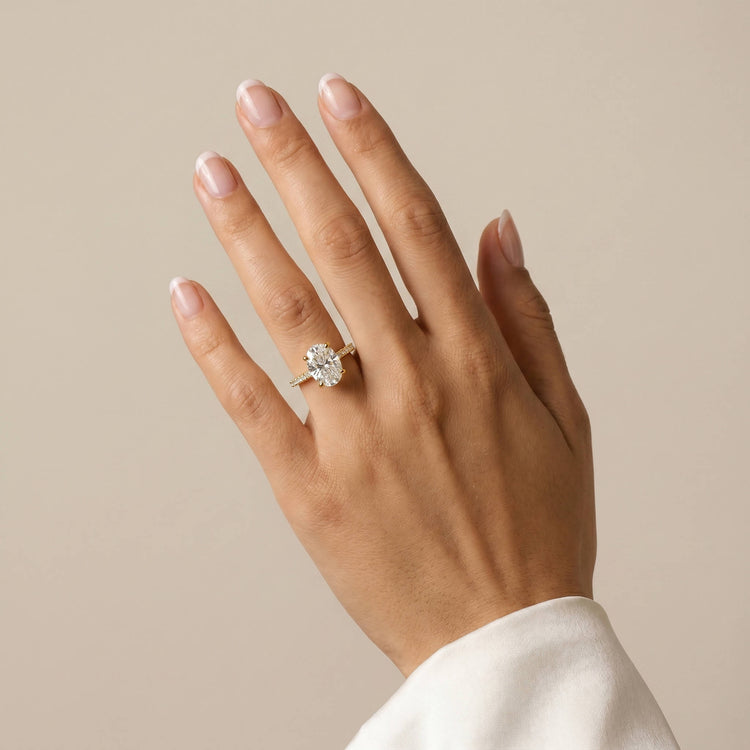
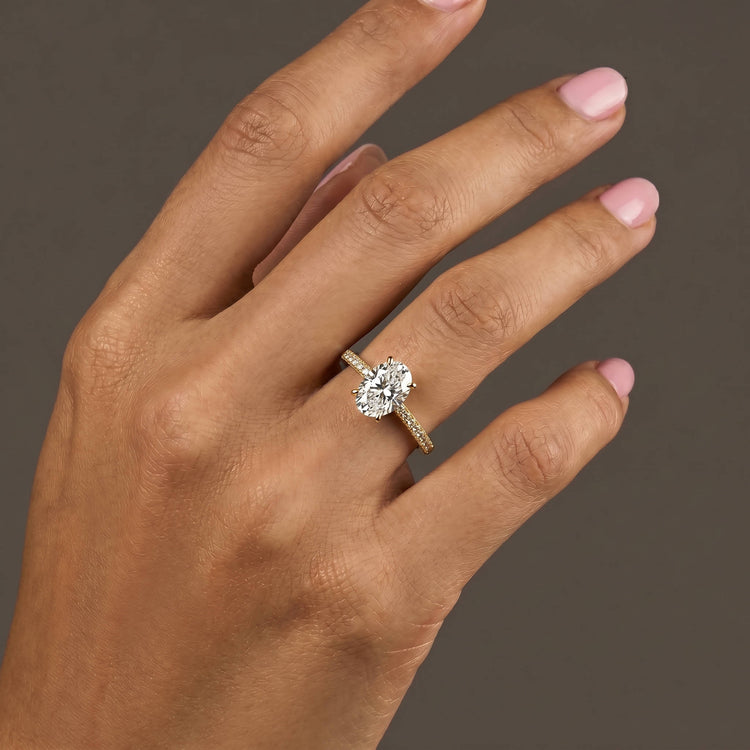
Few engagement ring combinations feel as effortlessly romantic as an oval diamond paired with a hidden halo. The elongated shape already has a graceful, finger-lengthening quality. Add a secret row of diamonds tucked beneath the center stone, and you get a ring that photographs as a classic oval solitaire from above but reveals a layer of unexpected sparkle from the side. At Leonids Jewelry, the hidden halo collection includes several oval designs that demonstrate exactly why this combination has become one of the most requested styles in lab-grown diamond engagement rings.
If you are shopping for an oval engagement ring with a hidden halo, you have likely noticed a gap in what is available online: most guides cover hidden halos broadly, but oval diamonds interact with hidden halos differently due to their elongated shape and deeper pavilion. This guide focuses exclusively on what makes the oval + hidden halo combination work -- ratios, carat weights, metal pairings, band compatibility, and the practical questions most general guides skip.
What Is an Oval Hidden Halo Engagement Ring?
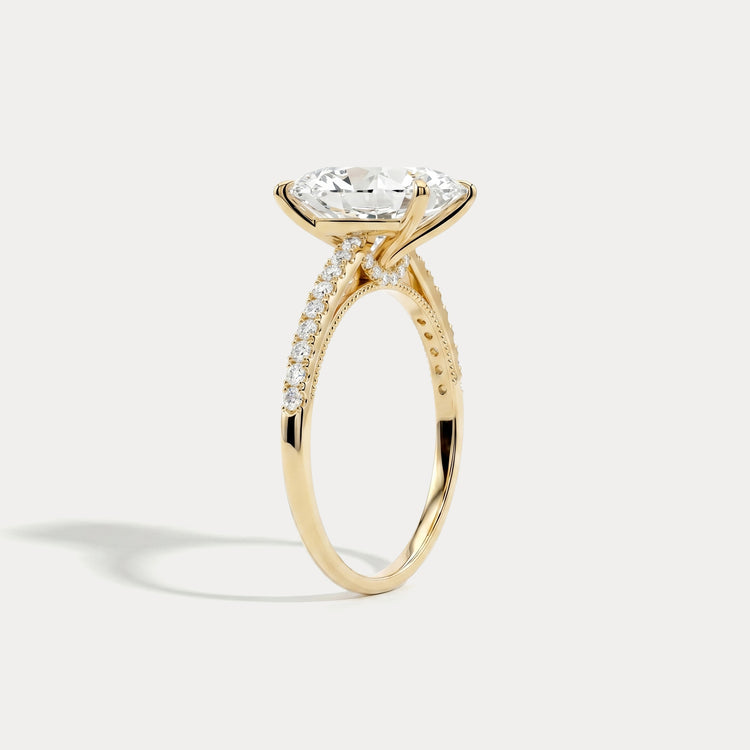
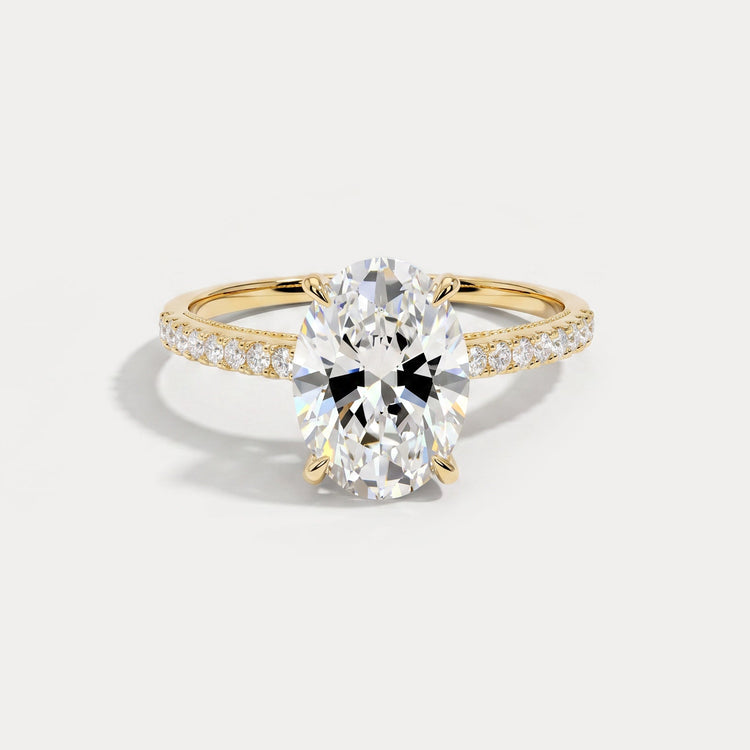
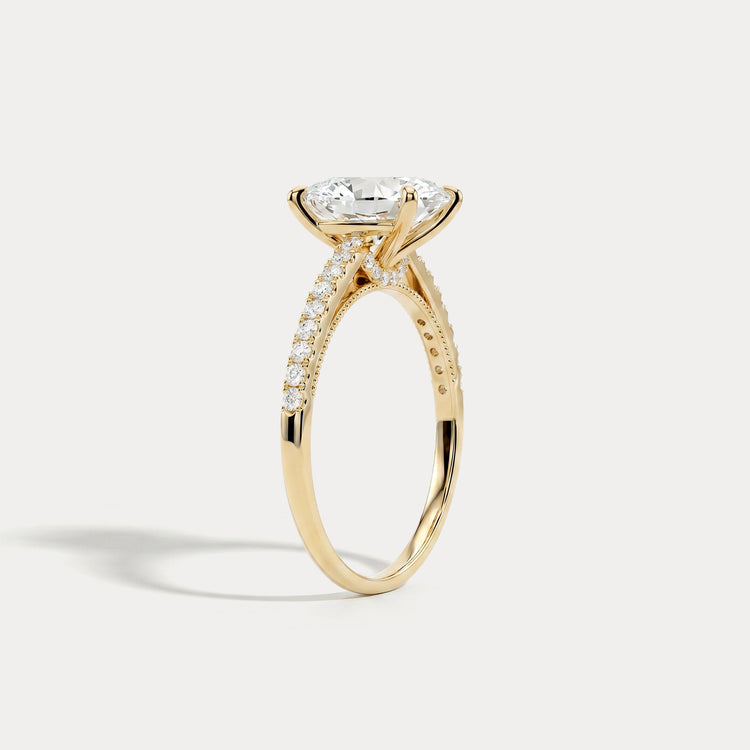
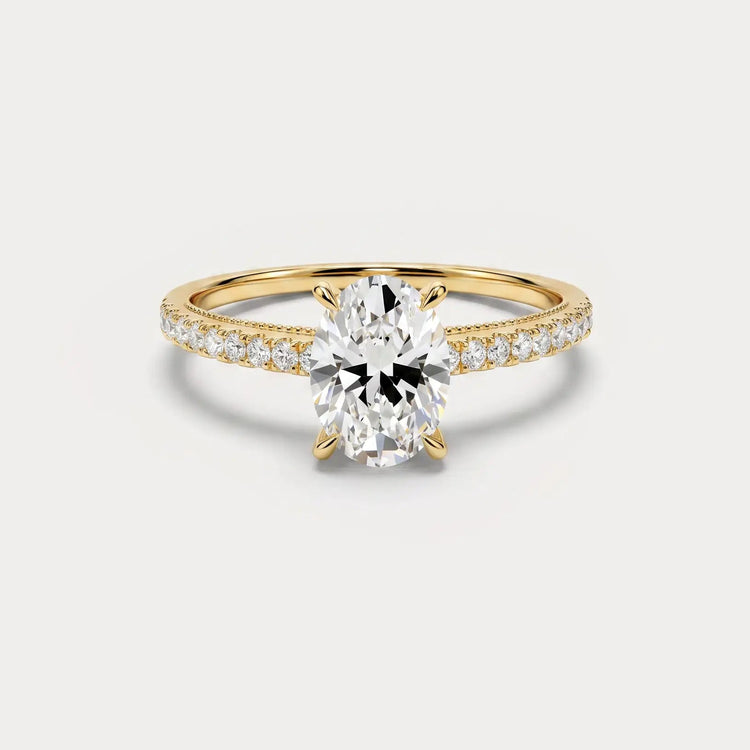
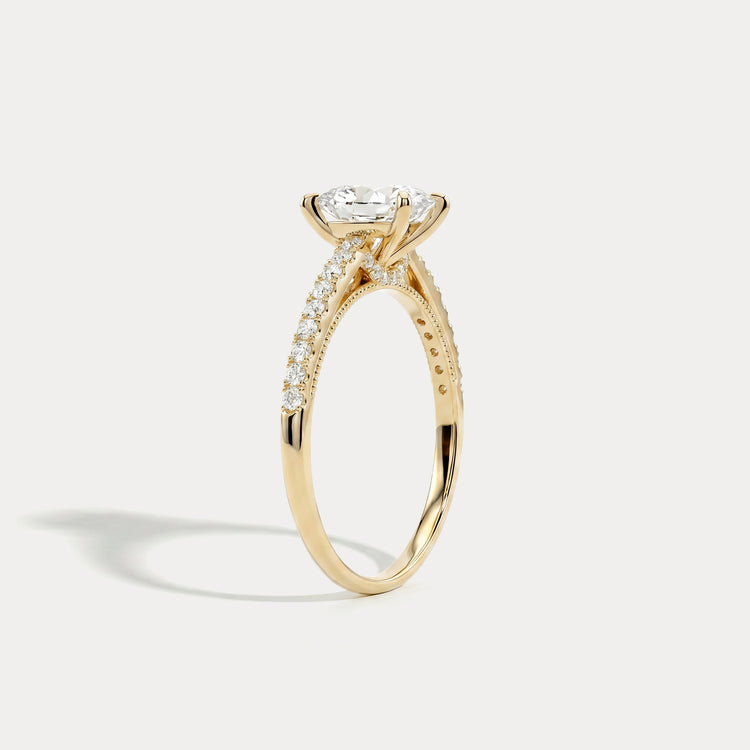
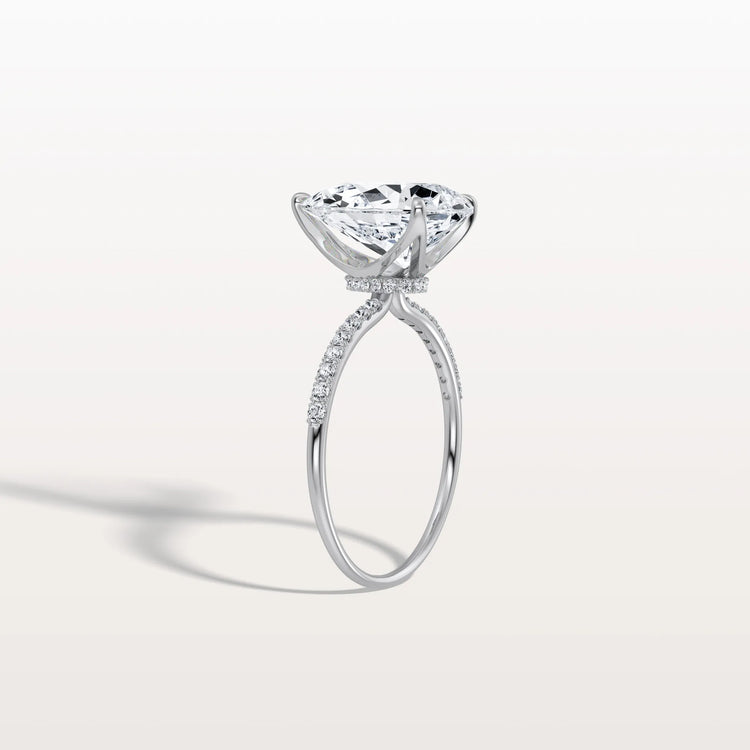
An oval hidden halo engagement ring has two defining features: an oval-cut center diamond and a ring of small accent diamonds set underneath the center stone, visible only from the side profile. From the top-down view, the ring reads as a classic oval solitaire. From the side, the hidden halo catches light and creates a subtle shimmer around the base of the center stone.
Most designs use 12 to 20 accent stones, totaling 0.05 to 0.15 carats -- far fewer than a traditional visible halo (30 to 50+ stones). The setting structure is typically a peg head or cathedral, each affecting how the halo presents from the side.
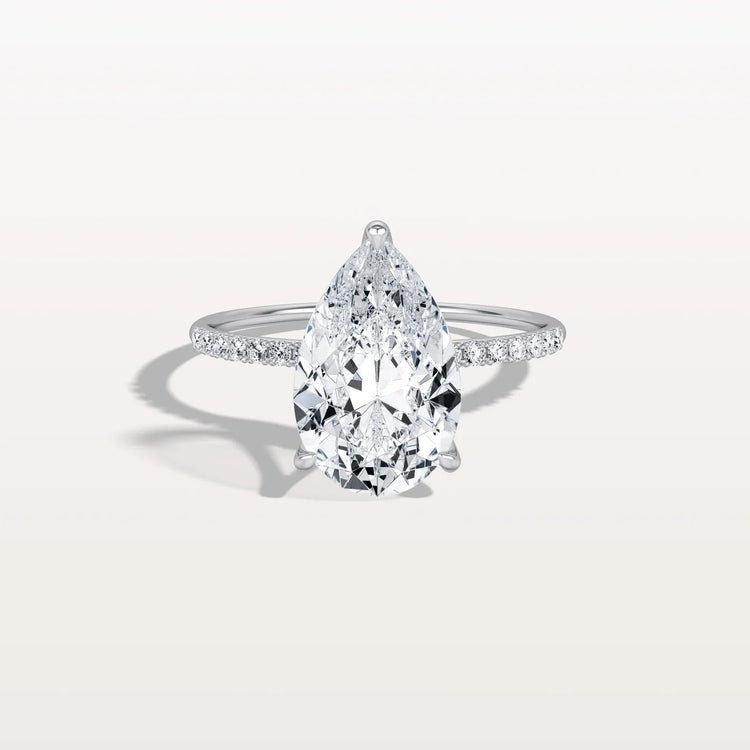
For a visual reference, the Lucia Oval Hidden Halo Engagement Ring demonstrates the classic oval hidden halo structure: a sleek gallery with pavé diamonds encircling the base of the center stone.
Why Oval + Hidden Halo Is a Perfect Match
Not every diamond shape pairs equally well with a hidden halo. Round brilliants work with most settings, and elongated shapes like emerald cuts can struggle with gallery depth. The oval cut sits in a sweet spot that makes it one of the most popular and visually successful shapes for a hidden halo setting. Here is why.
Oval diamonds have naturally deep pavilions. The oval cut is a modified brilliant with pavilion depth typically 58% to 63% of total depth. This creates generous gallery space -- the gap between girdle and culet -- where accent diamonds can sit comfortably. Emerald cuts with shallower step-cut pavilions have less room in comparison.
The elongated shape benefits from added dimension. An oval solitaire can look flat in profile at lower carat weights. A hidden halo adds a second layer of depth without changing the clean top-down look -- solving the "flat solitaire" problem without the visual weight of a full halo.
Oval halos dominate hidden halo search interest. "Hidden halo oval engagement ring" generates approximately 880 monthly searches, with variants adding another 780 -- roughly 1,660 monthly searches across just three terms. Within the broader hidden halo category, oval is the most searched shape.
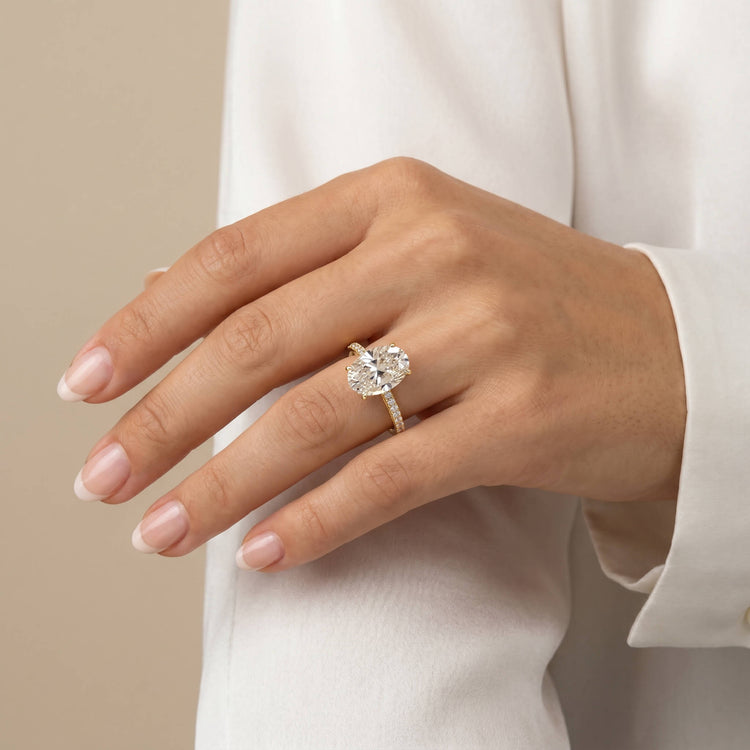
The finger-lengthening effect gets a bonus. An oval diamond already elongates the finger visually. When the hidden halo adds a subtle glow at the base, the eye is drawn to the length of the diamond from multiple angles. The result is a ring that feels elegant and proportional even in moderate carat weights.
Oval Ratio Guide for Hidden Halo Settings
The length-to-width ratio is the single most important variable when choosing an oval diamond for a hidden halo setting. It affects how the hidden halo sits under the stone, how the ring balances on the finger, and how the accent diamonds align with the oval contour.
|
Ratio Range |
Appearance |
Hidden Halo Compatibility |
Best For |
|
1.30 - 1.35 |
Slightly elongated, closer to round |
Excellent -- wide gallery area, easy halo alignment |
Buyers who want a softer oval shape |
|
1.35 - 1.45 |
Classic oval (most popular) |
Excellent -- the sweet spot |
Most buyers; this is the standard |
|
1.45 - 1.50 |
Distinctly elongated |
Good -- narrower gallery but still workable |
Buyers who prioritize finger length |
|
1.50 - 1.60 |
Very elongated, slender |
Fair -- tight gallery, halo stones may appear crowded |
Buyers seeking a dramatic look |
|
Above 1.60 |
Extremely elongated (close to moval) |
Challenging -- narrow pavilion limits halo placement |
Not recommended for hidden halo |
The 1.35 to 1.45 range is the most popular for a reason. It provides enough width for the hidden halo accent diamonds to sit comfortably under the girdle without looking cramped, while maintaining the elegant oval silhouette that buyers want.

A practical tip: if you are buying online, request a side-profile photo. The hidden halo should form a clean, evenly spaced arc under the center stone. If the accent diamonds look pinched, the ratio may be too narrow for that particular setting design.
Pros of an Oval Hidden Halo Ring
Clean, timeless top-down look. From above, an oval hidden halo ring looks like a classic solitaire. This is the single biggest draw: a clean, uninterrupted silhouette with a detail that makes the ring feel personal and considered.
Unexpected sparkle from the side. The hidden halo catches light at angles a plain solitaire cannot. When you turn your hand, the accent diamonds create a subtle shimmer that people notice -- often with a "wait, what was that?" reaction.
The oval shape elongates fingers. Coupled with the minimal top-down profile, an oval diamond makes fingers appear longer and slimmer without side stones or a split shank.
Pairs beautifully with most wedding bands. Unlike a visible halo which can clash with a diamond band, the hidden halo does not interfere with the top-down profile. You can wear a pavé band, plain metal band, or contoured band without the rings fighting for attention. More on this in the wedding band section.
Generally more affordable than a full halo. A hidden halo uses 12 to 20 accent stones versus 30 to 50+ for a visible halo. Less labor, fewer stones, lower cost. The hidden halo premium is typically 10% to 15% over a solitaire, versus 25% to 40% for a full halo.
What to Consider Before Buying
No setting suits everyone. Here are the practical trade-offs.
The hidden halo is invisible from your own perspective. When you wear the ring and look down, you see the top of the center stone and the band. The hidden halo faces outward and downward -- others see it more often than you do. If your enjoyment comes from what you personally see day to day, a hidden halo may deliver less satisfaction than a visible halo or detailed gallery.
Side stones on the band can compete with the hidden halo. A pavé band already adds side-view sparkle. Adding a hidden halo on top of that can create visual noise from the side profile. If you want both, consider a hidden halo with a plain metal band, or a pavé band without the hidden halo. The Melina Oval Solitaire shows a pavé band without a hidden halo for comparison.
Cleaning takes slightly more effort. The space between the oval diamond and the hidden halo collects lotion, soap residue, and everyday debris. A plain solitaire wipes clean in seconds. A hidden halo needs a soft brush under the center stone every few weeks.
Some wedding bands will leave a gap. Because the hidden halo extends below the center stone, a straight wedding band may not sit flush -- leaving a small gap where the halo protrudes. This is structural, not a defect. Workarounds are covered in the wedding band section.
Resizing can be limited. The hidden halo structure integrates the setting head with the shank more than a simple peg-head solitaire. Sizing by more than one full ring size may require rebuilding the setting head -- confirm resizing range with your jeweler before purchasing.
For further comparison between hidden halo and completely clean settings, our Hidden Halo vs No Halo guide walks through the trade-offs in more detail.
Who Might Prefer Another Oval Setting?
An oval hidden halo is a versatile design, but it is not the ideal choice for every buyer. You may prefer another oval setting if:
-
You want maximum visible sparkle from every angle.
-
You prefer the simplest possible ring with minimal maintenance.
-
You dislike cleaning around accent diamonds.
-
You want a completely minimalist look with no hidden details.
An oval visible halo may be a better fit if your goal is to maximize sparkle and make the center diamond appear larger. An oval solitaire is often the best choice for buyers who value simplicity, timelessness, and easy maintenance. For active lifestyles, an oval bezel setting provides the highest level of protection by surrounding the diamond with a metal rim.
The best setting is not necessarily the one with the most features. It is the one that matches your lifestyle, aesthetic preferences, and long-term expectations.
Best Metal Colors for Oval Hidden Halos
The metal color you choose affects how the hidden halo reads visually and how the accent diamonds perform. Here is how each metal interacts with an oval hidden halo design.
|
Metal |
Hidden Halo Visibility |
Diamond Contrast |
Best For |
|
White Gold |
High -- white metal blends with diamonds, halo almost floats |
Low contrast, seamless look |
Buyers who want the halo to blend into the setting |
|
Platinum |
Highest -- bright white finish makes halo nearly invisible |
Minimal contrast, cleanest look |
Buyers prioritizing durability and a seamless finish |
|
Yellow Gold |
Medium -- warm metal contrasts with white diamonds |
High contrast, halo clearly visible |
Buyers who want the hidden halo detail to be noticed |
|
Rose Gold |
Medium-High -- pink undertone creates subtle contrast |
Moderate contrast, romantic warmth |
Buyers seeking a unique, warm aesthetic |
White gold and platinum create the most seamless look. The accent diamonds nearly disappear into the metal, making the surprise effect more dramatic when someone notices the sparkle from the side. For further reading, see our White Gold vs Platinum comparison.
Yellow gold creates intentional contrast. The warm metal makes the white accent diamonds pop visibly from the side profile. This is a good choice if you want people to notice the hidden halo without you having to point it out. For buyers deciding between metal colors, our Yellow Gold vs White Gold guide breaks down appearance, maintenance, and cost.
Rose gold occupies a middle ground -- warm enough to create contrast, but with a pink undertone that feels softer and more romantic than yellow gold's brightness. It pairs especially well with oval diamonds that have faint warmth (G-H color grades), since the rose metal complements warmer diamond tones rather than fighting them.
Carat Weight Guide: 1, 2, and 3 Carat Oval Hidden Halos
Carat weight dramatically changes how an oval hidden halo ring looks and wears. Here is what to expect at each of the three most common sizes.
|
Carat Weight |
Approx. Dimensions (1.40 ratio) |
Hidden Halo Effect |
Finger Presence |
Typical Price Range (Lab Grown, G-H VS) |
|
1.00 ct |
7.7 x 5.5 mm |
Subtle -- halo adds modest depth |
Delicate, everyday wearable |
$1,200 - $2,000 |
|
2.00 ct |
9.6 x 6.8 mm |
Balanced -- halo proportionally visible |
Noticeable but not overwhelming |
$2,500 - $4,500 |
|
3.00 ct |
11.2 x 8.0 mm |
Dramatic -- gallery depth creates prominent halo |
Statement piece, high presence |
$4,500 - $8,000 |
1 carat. At roughly 7.7mm long, the hidden halo adds delicate depth without overwhelming the stone. Popular for buyers wanting a dainty, everyday ring.
2 carat. The sweet spot for most buyers. At roughly 9.6mm, the center stone commands attention while the hidden halo fills a gallery depth substantial enough to be noticed. The Lucia Oval Hidden Halo Ring is available in multiple carat weights, demonstrating proportional halo scaling.
3 carat. At 11mm+, the center stone dominates. The hidden halo here serves a different function -- adding structural presence and preventing the ring from looking top-heavy. A statement piece.
For buyers shopping across different carat weights, the Hidden Halo Collection offers oval options across all three weight tiers so you can compare proportions directly.
Cathedral vs Peg Head for Oval Hidden Halos
The setting structure that holds the center stone above the hidden halo matters more for ovals than for round diamonds. Ovals are longer, which means the setting head must support more cantilevered weight.
|
Setting Type |
Structure |
Gallery Visibility |
Security |
Ring Stacking |
|
Peg Head |
Single post under center stone, soldered to shank |
Maximum -- full gallery exposed |
Moderate -- single attachment point |
Straight bands may gap |
|
Cathedral |
Arched shoulders rise from shank to support center stone |
Good -- gallery partially framed by arches |
High -- three attachment points |
Better flush fit with bands |
Peg head settings expose the maximum gallery -- the hidden halo is fully visible from every side angle. The trade-off: the elongated oval rests on a single post, and for ratios above 1.45, that leverage can become a structural concern.
Cathedral settings add metal arches that partially frame the gallery from the sides. They are structurally stronger for ovals (three attachment points vs one) and allow a wedding band to sit more flush against the engagement ring.
For a deeper dive into how setting structure affects ring appearance and longevity, see our Cathedral vs Solitaire Setting comparison.
[VISUAL: Side-by-side comparison -- peg head oval hidden halo vs cathedral oval hidden halo, highlighting gallery exposure differences]
Wedding Band Pairing with Oval Hidden Halos
Pairing a wedding band with an oval hidden halo ring requires more thought than pairing with a standard solitaire. The hidden halo extends below the center stone, which creates a physical obstacle for some band styles.
What works well:
- Contoured or curved bands. Designed to bend around the setting head, accommodating the hidden halo protrusion for a flush fit.
- Open or gap bands. A deliberate opening frames the engagement ring's setting head, creating a nested, intentional look.
- Thin straight bands (1.5mm-2mm). May slide under the hidden halo if the setting sits high enough above the finger. Depends on the specific ring design.
- Spacer bands. A 1mm plain metal band worn between the engagement ring and wedding band prevents rubbing.
What to avoid:
- Thick straight bands (3mm+). Will leave a noticeable gap -- the halo physically prevents flush contact.
- Pavé bands without a spacer. If accent diamonds from both rings rub against each other, both can chip over time. A spacer band prevents this.
The Classic Wedding Bands Collection includes curved options that complement oval hidden halo settings without introducing gaps or friction.
For buyers who want a completely flush band fit, a bezel-set oval solitaire like the Sophia Oval Bezel Ring may be a better choice -- bezel settings sit lower and allow most straight bands to sit flush. Our Types of Bezel Settings guide covers the options.

Oval Hidden Halo vs Other Oval Settings
How does an oval hidden halo compare to other popular oval engagement ring settings? Here is a side-by-side comparison of the four most common choices.
|
Feature |
Oval Hidden Halo |
Oval Solitaire |
Oval Visible Halo |
Oval Bezel |
|
Top-down look |
Clean solitaire appearance |
Pure solitaire |
Halo of diamonds around center |
Clean metal frame around center |
|
Side detail |
Hidden diamond ring visible from sides |
Plain gallery |
Full halo visible from all angles |
Solid metal frame, no side stones |
|
Finger presence |
Moderate -- halo adds depth |
Lowest -- all focus on center stone |
Highest -- maximum sparkle |
Moderate -- metal frame adds substance |
|
Wedding band flexibility |
Some limitations (gap issues) |
Maximum -- nearly any band works |
Limited -- bands can clash |
Good -- low profile helps band fit |
|
Maintenance |
Moderate (clean under center stone) |
Low (easy to wipe clean) |
Moderate-High (many small stones) |
Low (metal frame protects stone) |
|
Durability |
Good (accent diamonds protected under stone) |
Excellent (fewest small stones to lose) |
Moderate (exposed small stones) |
Excellent (bezel protects edges) |
|
Relative cost |
+10-15% over solitaire |
Baseline |
+25-40% over solitaire |
+5-15% over solitaire |
For buyers who prefer the cleanest possible look with minimal maintenance, a classic oval solitaire may be the better choice. The hidden halo is for buyers who want the solitaire look from above but crave a detail that makes the ring feel personal.
For buyers drawn to maximum sparkle, a visible halo oval ring delivers more brilliance from every angle -- but at the cost of a busier top-down profile and less wedding band flexibility.
Care and Maintenance
Oval hidden halo rings require slightly more attention than plain solitaires but far less than rings with exposed pavé bands. Here is what to do:
Weekly cleaning. Soak the ring in warm water with mild dish soap for 10 to 15 minutes. Use a soft-bristle brush to clean between the bottom of the oval diamond and the hidden halo -- the primary debris trap. Rinse and pat dry with a lint-free cloth.
Avoid ultrasonic cleaners for peg-head settings. The vibration can loosen hidden halo accent diamonds, especially in peg-head designs with a single attachment point. Cathedral settings are more resilient but should still limit ultrasonic use to every 2-3 months, with a jeweler check afterward.
Inspect prongs every 6 months. The prongs holding the center stone and each accent diamond experience daily wear. A jeweler can check these in under 5 minutes, usually at no charge.
Remove the ring for heavy activity. This applies to all engagement rings but is especially relevant for hidden halo designs: hitting the side of the ring against a hard surface can dislodge the hidden halo accent diamonds, which are held by micro-prongs. Remove the ring for gym, gardening, swimming, and any activity involving impact or chemicals.
Is an Oval Hidden Halo Right for You? A Decision Checklist
Run through these questions. If you answer "yes" to most, an oval hidden halo is likely a strong match.
1. Do you want the top-down look of a classic oval solitaire?
2. Do you enjoy jewelry details that reward close inspection?
3. Are you comfortable knowing that you will see the hidden halo less often than others will?
4. Does your preferred wedding band style work with a setting that may create a small gap? (Or are you open to curved/open bands?)
5. Are you choosing a carat weight (1.5ct+) where the oval's gallery depth gives the hidden halo room to shine?
6. Are you comfortable with slightly more maintenance than a plain solitaire requires?
7. Do you want a ring that feels personal and considered without the visual weight of a full halo?
If you answered "no" to questions 3, 4, or 6, a plain oval solitaire may suit your preferences better.
If you answered ”no”; to question 1 (you want more visible sparkle), consider a visible halo oval ring or explore our Emerald Cut collection for a different elongated shape with its own halo options.
Ready to explore oval hidden halo rings? Browse the Hidden Halo Engagement Ring Collection to see oval, round, pear, and other shapes with hidden halo settings -- all featuring IGI-certified lab-grown diamonds and recycled precious metals.
Share