Oval Lab Grown Diamond Buying Guide: Size, Quality, Settings & Price
Published:
Quick Answer: How Do You Choose an Oval Lab Grown Diamond?
Choose an oval lab grown diamond by comparing its actual dimensions, length-to-width ratio, and light performance—not carat weight alone. A ratio of 1.35–1.50 is a useful starting point, but no number guarantees beauty. Look for balanced symmetry, lively sparkle, and a bow tie effect that is not overly dark. Then choose color, clarity, and a secure setting for your lifestyle and budget. Before ordering, confirm the diamond specifications, grading documentation, delivery timeline, and return eligibility.
Oval diamonds combine timeless elegance with an elongated shape and rounded edges that can make fingers appear more slender. Compared with a round diamond of the same carat weight, an oval may also look larger. Yet two stones with similar grades can look very different. This oval diamond buying guide explains how to compare quality, size, settings, and price before choosing your engagement ring.
Table of Contents
- What to Look for When Buying an Oval Lab Grown Diamond
- Oval Diamond Size Guide: 1 vs. 2 vs. 3 Carats
- Oval Diamond Cut Quality: Bow Tie, Proportions & Sparkle
- Best Color and Clarity for Oval Lab Grown Diamonds
- How to Choose the Right Oval Engagement Ring Setting
- Oval Lab Grown Diamond Prices: How to Get the Best Value
- Oval Diamond Buying Checklist: What to Confirm Before Ordering
- Final Thoughts: Finding Your Perfect Oval Diamond
1. What to Look for When Buying an Oval Lab Grown Diamond
Lab grown diamonds are real diamonds created in controlled environments rather than underground. They have essentially the same chemical, physical, and optical properties as natural diamonds, often allowing greater flexibility in carat size and ring design.
Begin with the 4Cs: cut, color, clarity, and carat weight, then consider features specific to the oval cut. Unlike a standardized round brilliant, oval diamonds are fancy shapes whose outlines and facet arrangements vary considerably.
Shape appeal: Smooth, rounded ends and evenly curved shoulders; bulging shoulders or flat sides may distort the silhouette.
Length-to-width ratio: Determines whether the stone appears full or elongated.
Light performance: Influences brilliance, sparkle, and contrast.
Symmetry and bow tie: Look for a balanced outline without persistent, distracting darkness across the center.
Diamond cutters balance these qualities with the weight of the rough. Therefore, stones of the same carat weight and clarity may look different. An independent report, such as one from IGI, documents graded characteristics, but cannot replace visual assessment. For online purchases, check whether images show the exact diamond or a representative design.
2. Oval Diamond Size Guide: 1 vs. 2 vs. 3 Carats
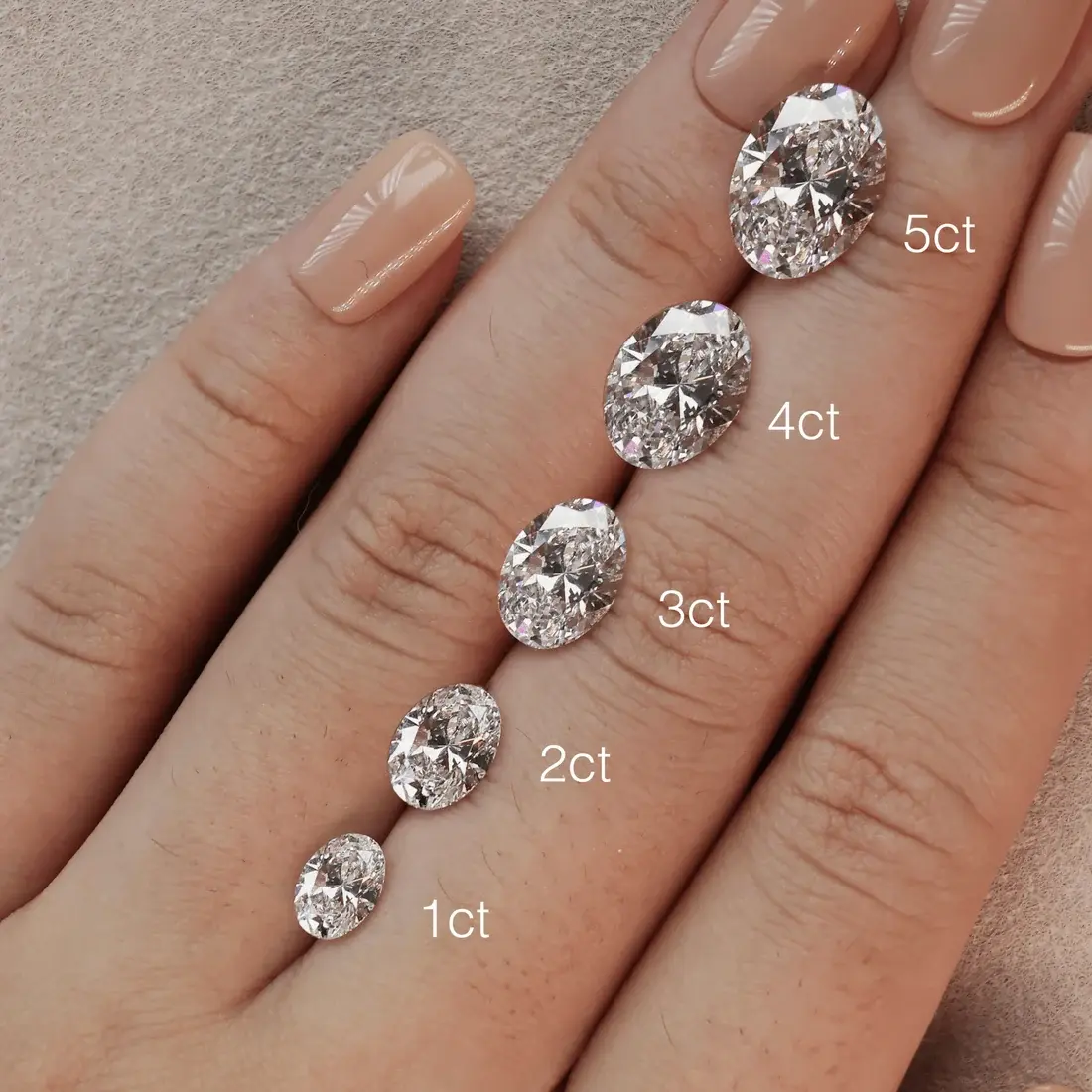
Carat measures mass, not visible size. Two oval diamonds of the same carat weight can differ in length, width, and face-up surface area because of their proportions and depth.
Leonids publishes the following reference measurements for its Melina oval engagement ring designs:
|
Center Stone |
Reference Dimensions |
General Appearance |
|
1 Carat Oval |
7.5 × 5.5 mm |
Delicate and understated |
|
2 Carat Oval |
10.0 × 7.0 mm |
Noticeable, balanced finger coverage |
|
3 Carat Oval |
12.0 × 8.0 mm |
Bold, prominent center stone |
These are Melina design references, not universal dimensions. Actual stones and other ring designs may vary.
2 Carat vs. 3 Carat Oval Diamond: How Much Bigger Does 3CT Look?
Although a 3 carat oval weighs 50% more than a 2 carat oval, it is not 50% longer. Using the Melina references, 3CT is 20% longer and approximately 14% wider. An elliptical estimate suggests about 37% more face-up area. The 2CT length-to-width ratio is roughly 1.43 versus 1.50 for 3CT, so the longer outline contributes to the difference.
For an oval diamond size chart on hand, compare images taken at the same distance, angle, and finger size. Band width and setting height also affect visual impact.
|
Your Priority |
Consider |
Why |
|
Noticeable size and budget flexibility |
2CT |
Leaves room for a setting or wedding band |
|
Greater visual presence |
3CT |
Offers broader finger coverage |
|
Understated elegance |
1CT |
Creates a refined, delicate look |
|
Everyday comfort |
Any size |
Fit and setting matter more than weight |
Bigger is not automatically better. Choose the appearance and proportions you enjoy. Explore Leonids' oval engagement rings to compare designs.
3. Oval Diamond Cut Quality: Bow Tie, Proportions & Sparkle
Cut quality affects a diamond's brightness, fire, and contrast. GIA provides overall cut grades for standard round brilliant diamonds, not ovals, though it evaluates their polish and symmetry. IGI offers a fancy-shape cut grading system incorporating proportions, craftsmanship, and light return. Neither a high clarity grade nor a favorable ratio alone guarantees beautiful sparkle.
Understanding the Bow Tie Effect
The bow tie effect creates dark areas across an oval diamond's center when facets reflect darker surroundings or light blocked by the viewer. A subtle bow tie may add character; a broad, persistent dark band can make the center appear lifeless. A GIA study of fancy-shaped diamonds found that observers generally disliked prominent, persistent bow ties, although preferences varied for subtler patterns.
Facet arrangement, viewing angle, and lighting matter more than depth alone. See our Oval Diamond Bow Tie Effect Guide for a closer explanation.
Recommended Oval Diamond Proportions
The length-to-width ratio (L/W ratio) equals length divided by width. A 10 × 7 mm diamond has an L/W ratio of approximately 1.43. Around 1.30 looks fuller, while 1.50 creates a more elongated shape; the ideal length depends on personal preferences.
IGI's published Excellent Oval Brilliant criteria provide these screening ranges:
|
Measurement |
IGI Reference |
|
Length-to-width ratio |
1.35–1.50 |
|
Total depth |
58%–63% |
|
Table percentage |
56%–62% |
|
Polish and symmetry |
Very Good–Excellent |
Source: IGI Fancy Shape Cut Grading Guidelines.
These are conditions within IGI's system, not universal guarantees. A final grade also considers other factors, including bow tie visibility and light return. A diamond outside these ranges can still be attractive. Compare outlines visually and read our Oval Length-to-Width Ratio Guide for detailed examples.
4. Best Color and Clarity for Oval Lab Grown Diamonds
Higher grades do not always produce a visible improvement worth their higher price. Aim for a stone that looks beautiful rather than the highest numbers on a report.
Color: D–F diamonds are colorless on the GIA scale; G–H are near-colorless and may still look bright and white. Some oval diamonds reveal warmth near their rounded ends. White gold and platinum create a cooler appearance, while yellow gold can complement warmth. Lighting and the individual stone matter.
Clarity: VS2 is a useful starting point, and some SI1 diamonds appear eye-clean. VVS inclusions are very difficult to see at 10× magnification, but the extra grade may not change everyday appearance. Inclusion size, position, and type are more useful than the label alone.
Leonids lists average E color and VS clarity for Melina 2CT and 3CT designs. These are published averages, not a guarantee that every diamond has identical grades. Confirm the specifications for your order and when its IGI documentation will be provided.
5. How to Choose the Right Oval Engagement Ring Setting
A setting changes a ring's appearance, comfort, edge protection, and wedding-band compatibility. Choose for your lifestyle, not just the photograph.
|
Your Preference |
Setting |
Main Consideration |
|
Classic simplicity |
Solitaire |
Highlights the center stone; check prongs and band |
|
Decorative detail |
Hidden halo |
Adds sparkle below the center; check band fit |
|
Symbolic design |
Three-stone |
Creates a richer silhouette with side stones |
|
Modern look and edge coverage |
Bezel |
Surrounds the stone with protective metal |
|
Distinctive orientation |
East-west |
Sets the oval horizontally across the finger |
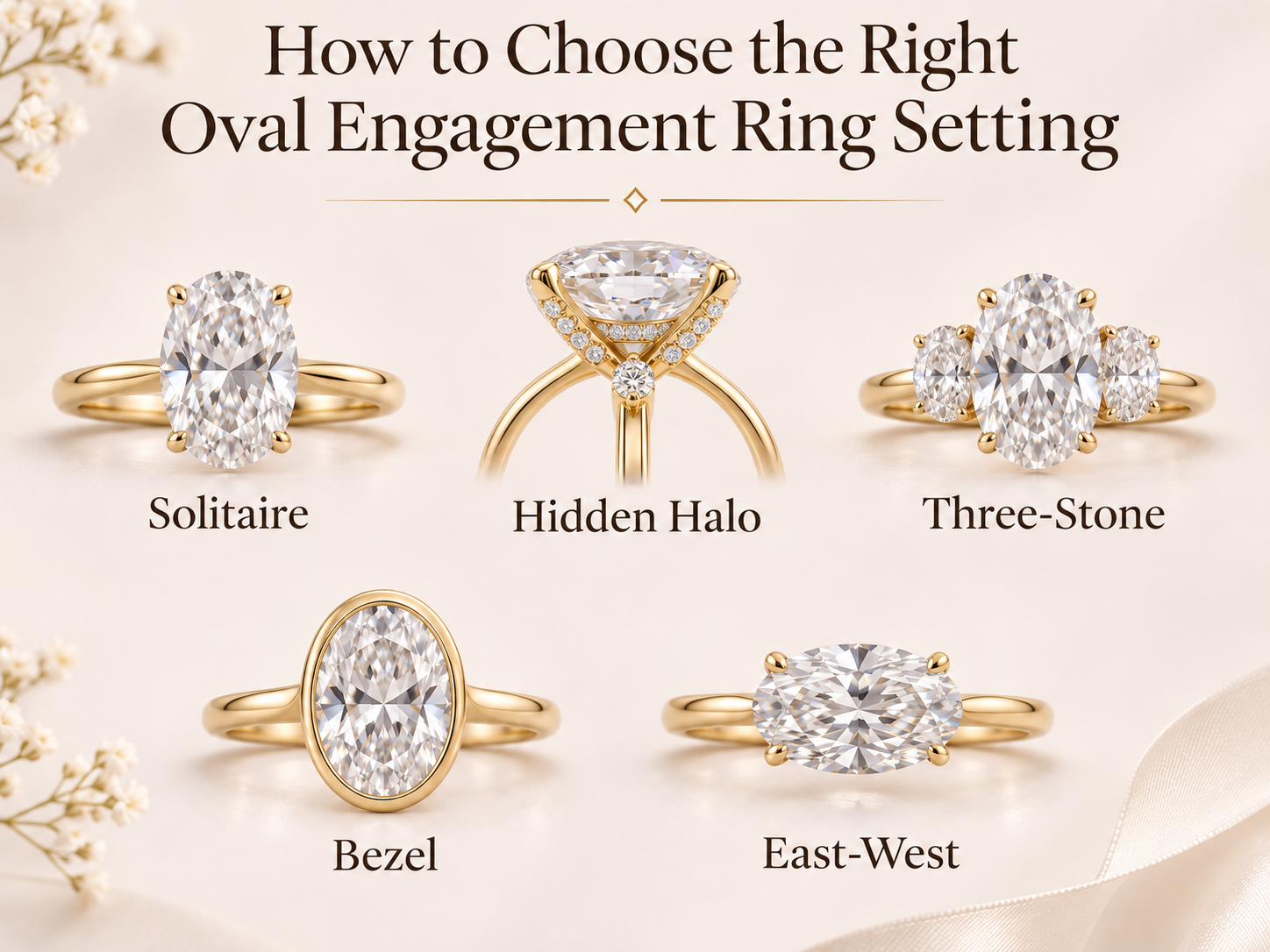
The image is AI-generated to help illustrate the characteristics of different styles of oval lab-grown diamond engagement rings. For specific details, please refer to the actual product images and videos.
A prong setting leaves more of the center stone visible but needs periodic inspection. A bezel provides added protection, though no setting eliminates damage risk. A halo can make the overall ring appear larger without improving the center diamond's intrinsic brilliance.
For frequent hands-on activities, consider a secure, relatively low-profile setting, and remove fine jewelry during high-impact tasks. Thin bands emphasize larger stones, while broader bands feel more substantial; extremely thin bands may sacrifice durability. Leonids offers various 10K, 14K, and 18K gold options and platinum. Consider metal maintenance, setting height, comfort, and whether your wedding band will sit flush.
Browse oval engagement ring settings at Leonids.
6. Oval Lab Grown Diamond Prices: How to Get the Best Value
The price of an oval lab grown diamond reflects carat weight, color, clarity, cutting, and market conditions. The finished engagement ring also includes metal, side stones, setting design, and craftsmanship. Compare complete rings with matching configurations—not loose diamonds or unrelated starting prices.
Melina 2CT vs. 3CT: A Real Product Comparison
Both Melina designs feature a four-prong cathedral setting, double-row pavé shoulders, milgrain details, and a hidden halo.
|
Feature |
Melina 2CT |
Melina 3CT |
|
Center weight |
2.00 ct |
3.00 ct |
|
Reference dimensions |
10.0 × 7.0 mm |
12.0 × 8.0 mm |
|
L/W ratio |
Approx. 1.43 |
Approx. 1.50 |
|
Listed average color/clarity |
E / VS |
E / VS |
|
Displayed starting price* |
$1,830 |
$2,470 |
Starting prices shown in November 2026 may change or reflect different variants. They are not a verified same-configuration upgrade quote. Select identical metal and comparable options to compare final totals.
The Melina 2CT suits buyers who want noticeable finger coverage while preserving budget flexibility. The Melina 3CT suits those who prefer stronger visual impact and a longer silhouette.
How to decide: Prioritize appealing shape and light performance, then choose a carat size that fits the total budget. A classic solitaire emphasizes the center; a hidden halo adds detail; a bezel offers more edge coverage. Think of the ring as a personal purchase, not a guaranteed resale investment.
7. Oval Diamond Buying Checklist: What to Confirm Before Ordering
Before buying online, check the following:
Specifications: Confirm carat weight, reference dimensions, color, clarity, metal, setting, and ring size.
Imagery: Ask whether photos and videos show the exact diamond or a representative design, and which appearance standards apply.
Grading: Leonids says eligible individual diamonds of 0.5 carat or larger receive IGI reports. As rings are made to order, the final report number is not available before checkout; certificate details are provided after shipping.
Fit: Check band width, prong security, setting height, resizing options, and wedding-band compatibility.
Timing: Leonids generally lists about 15 business days for production plus approximately 3–5 business days for U.S. shipping; custom details may extend the timeline.
After-sales: Read the Refund Policy and FAQs. Because made-to-order and customized orders may have restrictions, confirm your order's eligibility before payment.
Final Thoughts: Finding Your Perfect Oval Diamond
The best oval lab grown diamond is not automatically the largest stone or highest grade. It balances proportions, sparkle, comfort, and price. Whether you prefer the elegant presence of 2 carats or the bolder impact of 3, compare actual dimensions and complete-ring options before deciding.
Explore Leonids' oval lab grown diamond engagement rings and find a design that suits your style.
FAQs
Is a 3 Carat Oval Diamond Too Big for Everyday Wear?
Not necessarily. A 3CT oval can be comfortable, but setting height, balance, ring fit, and personal habits matter more than weight. A secure, lower-profile design may better suit active wearers.
Does a Bigger Oval Diamond Have a More Noticeable Bow Tie?
No. Bow tie visibility depends on facets, proportions, viewing angle, and light performance—not carat weight alone. A larger well-cut oval may show less distracting darkness than a smaller one.
What Should I Check Before Buying an Oval Diamond Online?
Verify whether specifications and images describe the exact stone or a representative design. Understand the grading process, delivery estimate, resizing, warranty, and return terms before placing an order.
Share