What Is the Bow Tie Effect in Oval Diamonds? How to Spot a Good One
Published:
Quick Answer: What Is the Bow Tie Effect in Oval Diamonds?
The oval diamond bow tie effect is a dark, butterfly-shaped contrast pattern across the center of an oval diamond. It occurs when the diamond's facets reflect darker surroundings or light blocked by the viewer. Common in elongated diamond shapes, it is not necessarily a flaw. A slight bow tie can add depth, while a broad, persistent shadow may reduce visual appeal. To choose a beautiful oval diamond, examine its brightness and sparkle in motion rather than relying on grading reports alone.
What Is the Bow Tie Effect in Oval Diamonds?
The bow tie effect in oval diamonds appears as a dark, bow-shaped area stretching across the middle of the stone. It is common in fancy shapes such as oval, pear, and marquise diamonds.
Unlike inclusions or surface imperfections, a bow tie is an optical phenomenon influenced by how a diamond's facets reflect light and create contrast.
Some oval diamonds display a subtle bow tie that adds dimension, while others show a prominent bow tie that remains dark as the diamond moves. The goal is balanced brightness and sparkle, not eliminating every trace of contrast.
What Causes the Bow Tie Effect in Oval Diamonds?
The bowtie effect occurs when an oval diamond's facet pattern reflects darker areas of its surroundings toward the viewer. Your head and shoulders can also block incoming light, creating additional contrast across the center.
Unlike a round brilliant, an oval cut has an elongated shape that produces different light reflection patterns. Its proportions, facet arrangement, viewing angles, and lighting conditions influence bow tie visibility.
Importantly, a bow tie is not automatically evidence of light leakage or poor cut quality. Some darkness represents normal optical contrast.
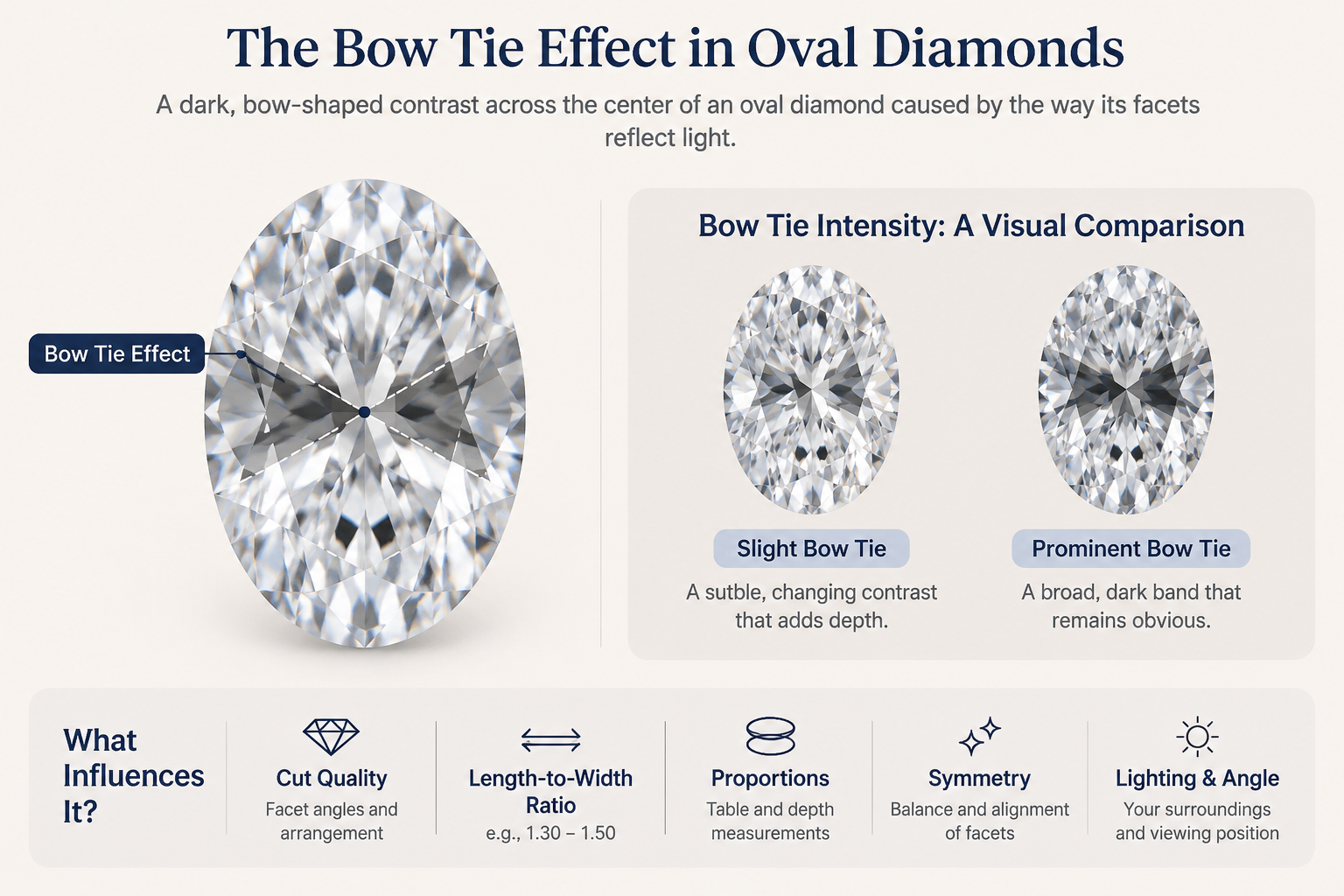
The image is AI-generated to help illustrate this phenomenon. The actual size/severity of the bow tie effect in a diamond varies depending on the lighting environment, proportions, and cut. Please refer to the product video for the actual effect.
Several factors affect its appearance:
Cut Quality: Facet angles and arrangement influence light return and brilliance.
Length-to-Width Ratio: A ratio of 1.30–1.50 is a useful starting point for shape preferences, not a guarantee of minimal bow tie.
Proportions: Table and depth measurements affect how facets interact with light.
Symmetry: Balanced facet alignment contributes to overall visual appeal.
No single measurement guarantees a bow-tie-free diamond.
How to Spot a Good Oval Diamond: 5 Things to Look For
When choosing an oval lab-grown diamond engagement ring, look beyond carat weight, color, and clarity. These five checks help reveal the full picture.
1. Look for a Balanced Bow Tie
Compare the diamond face-up and while gently rotating it. A narrow bow tie that brightens as the stone moves is generally less distracting than a broad, dark band that remains prominent. Judge overall brightness and sparkle, not the bow tie alone.
2. Evaluate Light Performance
A well-cut diamond should display appealing brightness, sparkle, and contrast. Examine both the center and ends of the oval for balanced light return, rather than focusing only on the dark area.
3. Compare Diamond Proportions
Consider the length-to-width ratio, outline, and measurements together. Two oval diamonds with similar proportions can display different bow tie patterns because their facet arrangements differ.
4. Watch the Diamond in Motion
Examine face-up videos as the diamond slowly rotates and tilts. Look for changes in brightness across the center. If possible, compare the stone under diffused and directional lighting. Persistent darkness from multiple angles deserves closer inspection.
5. Review the Grading Report
Check measurements, color, clarity, polish, and symmetry. GIA does not assign an overall cut grade to standard oval diamonds, while IGI offers fancy-shape cut grading on applicable reports. IGI's methodology considers bow-tie appearance and light return, but neither laboratory provides a separate numerical bow-tie severity score. Always compare reports with actual images or videos.
Can You Avoid the Bow Tie Effect in Oval Lab-Grown Diamonds?
Both natural and lab-grown oval diamonds can exhibit bow ties because the effect relates to facet arrangement and light performance, not diamond origin.
Higher color or clarity grades do not guarantee a less noticeable bow tie. Likewise, excellent symmetry alone cannot eliminate the effect.
Rather than insisting on a completely bow-tie-free diamond, prioritize balanced brilliance and minimal distracting darkness. A subtle, changing contrast pattern may be perfectly acceptable, depending on personal preference.
Final Thoughts: How to Choose an Oval Diamond with Beautiful Brilliance
The bow tie effect is a common characteristic of oval diamonds, but its visibility varies. A slight bow tie can add depth, while a broad, persistent shadow may diminish visual appeal.
Compare actual diamond videos, review grading details, and prioritize overall light performance over any single specification.
For relevant information, read Oval Diamond Length-to-Width Ratio Guide: 1.30 vs. 1.40 vs. 1.50; and whether you prefer a classic solitaire or a delicate hidden halo, explore Leonids Jewelry's Oval Lab-Grown Diamond Engagement Rings to find a design that reflects your style.
FAQs
1. Is the bow tie effect in oval diamonds bad?
Not necessarily. A slight bow tie can add contrast, while a prominent dark shadow may reduce visual appeal.
2. Do all oval diamonds have a bow tie?
Most oval brilliant diamonds exhibit some degree of bow tie, although visibility varies significantly.
3. How can you identify a strong bow tie?
Watch face-up videos under different lighting conditions. Look for broad, persistent darkness across the center.
4. Can a bow tie disappear in certain lighting?
Its visibility can change with lighting, viewing angles, and movement, but the underlying optical characteristics remain.
5. Does a 2 carat oval diamond have a stronger bow tie?
Not necessarily. Bow tie intensity depends primarily on facet arrangement and light performance, not carat weight alone.
Share